Showing posts with label Sun Microsystems. Show all posts

Wednesday, September 26, 2012

NetCAT 7.2 goodies and 7.3 just got started

The Netbeans Community Acceptance Testing (NetCAT) for v7.2 concluded at the end of July 2012. It was a very productive testing process for the Netbeans community. Details about the NetCAT 7.2 are here. Beyond improving the quality of our favourite IDE, depending on how much you have contributed, Oracle also gives out goodies to the participants.

netbeans-goodies

The goodies I received this time around includes a very large towel, a nice t-shirt, 2GB memory stick, notebook and pen, an acknowledgement letter detailing my contributions and points to the program and this new Oracle-branded mint!! Strong mint!! At least from the envelope, Sun is still alive… Hurray!!

If you’d like to get similar goodies or just improve the quality of Netbeans, participate in the NetCAT 7.3 which started 10 days back. Its not too late to participate. Signup to the mailing list and add yourself to this wiki page. You’ll get points for participating in discussions over email/forums, reporting bugs, participating in surveys and following a manual testing script by being part of Tribes that test specific functionality. So its not very hard… you just have to simply use the daily or beta builds and give feedback to the developers. Go for it!!

Tuesday, February 2, 2010

The first axe on Sun after Oracle acquisition

Although the hardware business and the way of working at Sun Microsystems would continue as outlined in a detailed 5hr marathon by Oracle Boss Larry Ellison, we have the first victim of the merger... and its the not-so-successful "Kenai" project hosting services from Sun Microsystems. According to the announcement, "It's with a sad heart that we have to announce that the Kenai.com domain will be shutdown as part of the consolidation of project hosting sites now that Sun is a wholly owned subsidiary of Oracle."

Kenai.com was never a good launch... Not a lot of marketing, nor a lot of support or projects jumped into their bandwagon. But it was kind of a nice set of features that Kenai.com was providing. It had source-code hosting with version control where you could choose between Subversion, Mercurial or Git. Issue tracking you could choose between JIRA and Bugzilla. It also provided you with mailing lists, wiki, forums, downloads, chat room etc. Basically covering most of the part of the web infrastructure that today open-source projects want. Nothing innovative or original, you get all of those at other places and probably somewhat better packaged, but Kenai definitely gave a lot of choices.

The announcement also mentions:
Project Kenai has always existed as two different things: Kenai the infrastructure, and Kenai the website (Kenai.com).  While it has come time to close the domain of Kenai.com, the infrastructure (which is already used under NetBeans.org) will live on to support other domains in the future.

So, you see the real added advantage for using Kenai was for developers and projects using Netbeans 6.8 because it was very nicely integrated. You could manage issues, code, forums etc from inside Netbeans. Nevertheless, its the death of one of the failed products of Sun Microsystems. This may just be the beginning where we see many axes chopping failed projects. Hopefully none of the huge, monolith trees get chopped, only because they aren't fetching money!

Saturday, August 8, 2009

OpenOffice Moving to Microsoft’s “Ribbon” Interface

Although a host of online word processors have come up, OpenOffice has been the only real competitor to Microsoft’s Office Productivity Suite. It is widely regarded as “one day will beat Microsoft” dream for most open-source evangelists. It supports Microsoft Office formats and provides great compatibility to edit documents and presentations in Linux. Infact, its been one of the goals of OpenOffice to be like Microsoft Office so that people can easily switch to it and get the same features for “free”.

And moving in that direction, in the next release, they are planning to copy the Ribbon interface of Office 2007. The Ribbon Interface has been one of the most talked about UI changes, some people hate it while others love it. In Windows 7, Microsoft has moved some basic applications like Paint, Notepad to the Ribbon interface. May be OpenOffice is just trying to get ready for Windows 7.

Ooo 

Try the new interface demo for Impress (Powerpoint alternative) with the new ribbon-like interface.

Monday, January 5, 2009

Computers have life? Hard-disk reacts badly to screaming

When J.C Bose first proved that plants have life, he used a crescograph and showed that pleasant music or a friendly chat with plants helped them grow faster. On the other hand, plants didn't like someone shouting on them... Now, as weird as it sounds, computers (hard-disks) also don't like it when someone shouts at them.

This was experimentally verified by Brendan Gregg from Sun Microsystems Fishworks lab where they create loud noises around a JBOD disk array. Due to the vocal vibrations, there is a spike in the I/O operations and a clear increase in the disk latency. The finding is interesting because it can be useful to make datacenters quieter to improve performance. The finding was put on Youtube on 31st Dec, 2008 and you can look at the video below:

So with that video you realize that computers don't like someone screaming at them. Next-time when Windows hangs on you, don't shout, your PC will slow-down further!! May be it has some form of life ;-)

Wednesday, November 19, 2008

Netbeans 6.5 Final Released

After some delay in the release due to quality issues, Netbeans 6.5 is out for download. It is netbeans 128 2 indeed a feature-rich build and some great changes have been added for this new release. Along with the new features, I can vouch that Netbeans 6.5 is also a pretty stable release since I was part of NetCAT 6.5 (Netbeans Community Acceptance Program).

The list of new features can be found here… My favorite features are the improvements in Database Query, Python, HTTP Client Monitor, JavaScript Debugger and PHP. If you are a developer from the php world, I would really suggest that you take a closer look at Netbeans 6.5. I love the documentation and code hints that Netbeans will give you.

Netbeans also completed 10yrs a few weeks back and celebrate by downloading Netbeans 6.5 here.

Wednesday, September 3, 2008

Students Review Contest for MySQL & Glassfish

Sun Microsystems has announced a students review contest for MySQL and Glassfish, where students have to develop an application using MySQL and Glassfish. The project has to be part of the java.net website and a review has to be written on MySQL and Glasssfish.

The contest is useful for students who are learning to develop web application and will also help Sun if students get interested in these products. The contest has the following prizes to be won:

  • A chance to win a grand prize of $500 in Visa debit card, and
  • Five chances to win a prize of $250 in Visa debit card

Other than the prizes, students should also be interested in the contest because its a nice learning experience and students will also improve their writing skills by blogging. There is also a certificate that is given to all the winners and its good to show-off you accolades. I won the 2nd prize on the students reviews contest last time and it was an interesting contest to participate.

Chhandomay Mandal manages these student contests and he's very polite and always ready to help. Ask him questions here.

Thursday, July 3, 2008

Solaris & Xeon Break Million Messages Per Second

Sun Microsystems today announced that it has collaborated with Intel to not only provide the best throughput performance to date by breaking the million-messages-per second barrier, but also the lowest available network latency on a 1Gb Ethernet. This performance output was generated on a new financial services benchmark known as Reuters Market Data System 6.0.3 (RMDS).

The Intel-based Sun Fire™ X4150 with Solaris 10 provided the top-notch results for the benchmark and it indeed is superlative performance to reach million-messages per second. And more importantly its done on standard network topology instead of stacked topology, which can improve scalability but comes at a cost. Doing it with standard 1Gb Ethernet is surely an achievement. The performance by the system is highly dependent on the hardware which Intel has engineered and Sun has built. But Solaris also has contributed to the improved performance. Solaris has the least latency in message passing and network performance on it is excellent.

Sun Microsystems CEO, Jonathan Schwartz applauded the new benchmark results and attributed much of it to Solaris. And he sure must be happy!! Sun Microsystems is very focused on Solaris/OpenSolaris these days with a lot of development work towards OpenSolaris. There is also a big PR machine running for openSolaris these days and some ol’ Netbeans guys have been moved to talk and explore the world on openSolaris. Sun Microsystems has got this target to make openSolaris big on the desktop with a distro-plan similar to Linux distros.

Congratulations to Sun on the new benchmark record!! It is definitely one of the strong forte for Sun to perform on the network, but the desktop move is a totally different ball-game. And why didn’t we have one of those largest hardware/microprocessor team from Sun make the system from UltraSPARC to perform that good instead of the Intel hardware ??

Monday, June 23, 2008

Niagara 3 Does 256-threads, But No Supercomputing ?

The Register claims to have learnt that the next version of Niagara processors from Sun Microsystems is going to be a 16-core and 16-thread/core processor. Sun-logo This means that the Niagara 3 will be doing 256 threads simultaneously. And we aren’t talking of some distant future plan, but Sun Microsystems will be releasing these processors in 2009.

If you did not know, Sun Microsystems has been selling the Niagara 2 processors which can run 64 threads simultaneously on 8-core processor. Niagara 2 is officially sold as UltraSPARC T2+ chips and has been the most successful processors from Sun’s lineup in recent years. Obviously with so many threads running simultaneously on a single chip means that the performance is screaming and is excellent value for money. There are 2 socket systems available as well as 4-socket systems with UltraSPARC T2+. Then there is also the Rock processors coming in 2009.

From what I heard 2 years back, UltraSPARC had the largest processor design team in the world. So it comes as no surprise that it has the best design and performance in multithreaded systems. They also open-sourced their older SPARC designs as part of OpenSPARC.net and have pledged to continue opensourcing the next-gen processors as well!!

But the sad thing is that UltraSPARC Tx processors haven’t been as big a hit in the HPC and supercomputer market. If you have a look at the list of top supercomputers for June 2008, you will realize that Sun Microsystems just figures once on the top 10. It features in the top 10 for Texas Advanced Computing Center at University of Texas and uses AMD’s Opteron processors and not UltraSPARC. In all of the 500 supercomputers, IBM rules the roost with 209 systems and HP comes second with 183 systems. IBM has been able to push POWER processors to build some awesome supercomputers whereas HP has taken Xeon and built powerful systems around it. Sun Microsystems on the other hand has just 4 supercomputer systems and all are with Opterons.

Most people would argue that single core performance proves to be more effective than multi-threaded performance in conventional supercomputer software and benchmarks. Processes are more common units of work than threads itself, but that’s where the overall system building plays its part. Like Seymour Cray has stated, “Anyone can build a fast CPU. The trick is to build a fast system.”

Wednesday, June 11, 2008

Sun Microsystems Does Awesome Web Throttling

Web Downloads can be a really painful for users as well as companies when you have a sudden surge of downloaders or traffic suddenly increases exponentially.sun_logo Most Linux distros these days ask people to use the Bittorrent downloads as a savior to prevent bottleneck on downloads... And on similar grounds, Sun Microsystems seems to have some excellent throttling going on with the downloads from their servers.

If you have recently downloaded something off Sun's web servers, you must have observed this phenomenon. When you try to download something from Sun's servers, the speed increases initially. Then after sometime the speed falls and steadies to slower than the initial speed. If you happen to use a download manager, you can stop and start the download again. The speed will increase and then fallback again... And then when your download is about to finish, all of a sudden the speed increases and you finish the downloads faster than you thought!!

You are probably guessing this may have been a one time thing, but I have done close to 100 different downloads in the last 1 week from the Sun servers from different locations and ISPs and the same thing happened everytime. May be its something in the Solaris or Apache or Virtualization or something else... Nor was my observation scientific enough...

Have you observed something similar?? Is Sun working on some load balancing web server and experimenting with it?? Either ways, I think web downloads are good places to employ throttling. For companies, large downloads are particularly useful with such practices, but for the users Bittorrent is definitely the way to go!!

Monday, May 19, 2008

Acrobat Reader Being Developed for Solaris x86

If you have downloaded the latest Solaris x86 (2008.05), and tried to download the Acrobat Reader, then you are like me and haven't found a version for your acro_icon newly installed OS. Adobe today announced that it is developing a version of Acrobat Reader for Solaris x86. But Adobe says that it'll be released only in 2009 and not this year.

The announcement reads:

This was, of course, not a straightforward decision - there are lots of dependencies that we need to deal with, including third-party dependencies, platform limitations, internal and external dependencies and resource constraints. These constraints are not always apparent but have to be dealt with when a huge product like the Reader needs to be ported to a new platform.

The announcement has two sad things for me. It is going to take too long to release and why hasn't Adobe already started working on it. PDF is like the standard for document sharing and it is widely used. Solaris is also a big platform, although the x86 move is a pretty new one. Adobe already has a version of Acrobat Reader for the Solaris SPARC platform. So it seems odd that making the dependencies is going to take so much time!!

Tuesday, May 13, 2008

JRuby Won & It Was Fun

JavaOne is all about interesting demos, latest buzz around Java and some painful marketing talks. I didn't attend JavaOne this year, but I've read a few stories online about the different keynotes, demos and followup discussions. I just finished a conversion with a group of friends/colleagues who attended JavaOne 2008 and most of them enjoyed the show.

One interesting session at JavaOne 2008 was hosted by Raghavan aka Rags from Sun Microsystems. The session was called the Script Bowl and was a war between the scripting gurus from Groovy, JRuby, Jython and Scala. All the four languages are dynamic scripting languages that run on the JVM. LaForge represented Groovy, Nutter represented JRuby, Wierzbicki represented Jython and Jorge Ortiz represented Scala. All four showcased excellent skills and I watched the video one of my friends had taken.

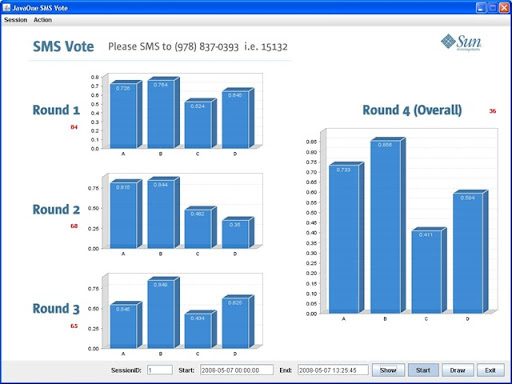
And like the Idol (American - Indian whatever...), there was SMS voting and it was awesome competition between the scripting languages and their crowd of supporters watching the session. Finally JRuby won the day and it was a close fight. JRuby won big points at Round 3 (Best Language Features). You can read the full competition details and look below for the result details:.

A = Groovy; B = JRuby; C = Jython and D = Scala

voting

Friday, April 25, 2008

Will The "Sun" Shine With x86 ??

Latest news has it that Sun Microsystems has bought a struggling x86 chip manufacturing called Montalvo Systems. Montalvo is known to have been in talks with Sun for quite some time and there were long running rumours that Montavlo would be bought. When I heard the rumours, for the first-time I had thought it would be crazy for Sun to get into x86, but now it seems they have actually bought the company for a bargain buy of $5.5 million.

Monalvo Systems is a fabless startup funded through venture capital. It raised about $73 million from the venture capitals, but needed more $100 million lately. It still hasn't made any money and hence was denied the request for additional capital. In comes Sun Microsystems and gets a bargain buy!! Now if you are like me, then you would be wondering, why would Sun Microsystems buy an x86 chip design startup. Montalvo doesn't have the clients nor the SPARC designs. Sun Microsystems has over the years talked us into the greatness of the SPARC architecture and x86 manufacturing is really not its game. But so wasn't Sun's software business...

Popular belief has it that Sun Microsystem is going to use Montalvo's technology in its SPARC chips. Montalvo seems to have an excellent IP and chip design team which Sun was interested in. Sun Microsystems also has an amazing chip design team and probably its the human resources which has resulted in this deal.

If this buy is another completely new strategy from Jonathan, then it would be one to really watch out for. Lately, Sun has been selling x86 servers with AMD Opteron and you never know what Sun is upto after the ticker change... From JAVA to x86 can't be a more dramatic change than the last time.

Monday, April 14, 2008

Java Applets Don't Run In Browser Anymore

If you had your Java textbooks tell you that "Applets are defined as programs that run in the browser", then you probably have to get a new revision of that textbook. Probably even authors and Java gurus need to change their definitions and refresh their ideas. And all this because from Java 6 update 10, applets will be able to execute on a process outside the browser through a nice new plugin.

Java 6 update 10 brings a whole new paradigm of applet development through the use of a new plugin for browsers. The applets running through the new plugin will feel like they are running inside the browser, but actually are executing on a different process outside the browser. The idea is that there is a lot of baggage that Applets carry when executing within the browser, thus slowing the user experience and taking an awful amount of time to load. The new browser plugin is supposed to work on:

  • Internet Explorer 6 and 7 on Windows XP and Windows Vista
  • Firefox 3 pre-release builds on Windows XP, Windows Vista, Solaris and Linux

The plugin does not work with Firefox 2, but Sun Microsystems expects someone from Mozilla to backport it. Opera, Safari and other people need to talk to Sun to get the plugin implemented. There is also a feature where you can switch between the old plugin and the new plugin. It all depends on which one do you want to use.

Applets have been a failed bet on Sun Microsystems part and you won't find many takers for Applets on today's Internet. Not that its a bad thing to use, but probably its download time, slow startup and not-so-seamless integration on webpages, made it a miss rather than a hit. Applets were supposed to be the defacto for active documents, but somehow didn't turn out to be that way. This is another push towards active documents or web deployed applications, but this time probably its more JavaFX.

The Kernel and Improved Updates

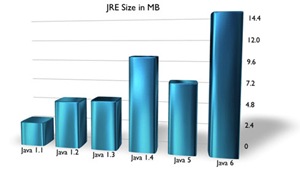
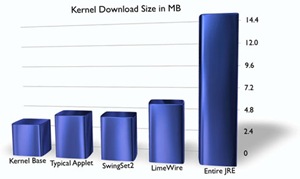
Another problem Java deployment generally faces is that it needs the JRE (Java Runtime Environment) to be deployed first on the client machine. Any update to JRE is a huge download and the size has been increasing with the addition of new APIs. A new feature, part of Java 6 update 10 (Java6u10) is the "Kernel" which only includes typical components required for your programs. It is a small package of 4-5 MB instead of the regular ~20MB.
JavaDwnld KernelDwnld

Download and Update Improvements

The complete list of new features can be found here. You can download the Java 6 update 10, which is still in beta from here and decide for yourself if its the right thing for you. I have downloaded it and from my assessment it seems to be an excellent release. Applications are a lot faster and cold startup of Java applications have improved dramatically.

The guys from Sun mention that its the biggest update release of Java that they have ever shipped without the API changes. One thing I love about Java and JRE is that they have improved the API quite a bit, but don't make the old programs incompatible. I hate the way for .NET we had completely separate v1.0, v1.1 and v2... for the .NET Framework.

Finally all the new improvements to JRE feels like the year2000 internet boom prediction where everything on the web is going to change. Silverlight, Adobe Air, JavaFX Script, and many many more technologies are all lined up to take the developer share. Which technology will rule in the end is a tough call to make, but this time all the buzz seems more real than the last bubble!!

Monday, March 17, 2008

Blog About netBeans 6.1 Beta And Win !!

The netBeans project is in beta with version 6.1 in the making and in a bid to encourage more people to talk about it they have released a contest. Its called the "NetBeans IDE 6.1 Beta Blogging Contest", where you have to download the beta, write a blog post and submit it. If you are among the chosen 10, then you 61blog-contest-logo-trans win $500 or 100 others win T-Shirts.

The contest is a nice idea to create buzz about the IDE. netBeans is really shaping up to be the all-rounder in terms of IDEs and with so many plugins, it is a good IDE. A nice mouth-to-mouth publicity by announcing this blogging contest. If you are a good blogger, use netBeans, like its features and want to spread the word, then blog about it. You may just win some goodies... But the last date for submitting your URL is April 18, 2008.

I have blogged about netBeans 6 earlier and may be I'll enter this contest as well. Its never enough to talk about things you like and it may just be worth it!!

Thursday, January 24, 2008

NetBeans Event in Second Life

Second Life, the virtual world where people live another life in front of their computers, is going to be the location for the next NetBeans meet on Jan 31, 2008 at 10 am. If you haven't heard of Second Life, then may be you first need to read this and then if you are tired of your real life, get the client and log in to your Second Life.

I am not a resident of Second Life since I don't have enough time in my first life, but I always wonder what's the point of a second life if you already have a first life. I mean one life at a time can be tough to manage, what do you do when you have to manage two!! But this event seems to be good excuse for any netBeans developer at office to experience something other than just typing some code on the keyboard. The netBeans event can be a good refresher and is a nice idea from Sun to talk about netBeans.

The event is being held at the Sun's property in Second Life and you can get the directions here. Infact, you can teleport from to the meet location from that page. Brian Leonard and David Botterill will lead the talk about NetBeans 6.0 and will be mainly about the new features in netBeans 6.0. It'll be good if we have a good crowd at the meet and life can get really interactive in the world of second life. Hopefully people are still left with some Linden Dollars (virtual money of Second Life) after the banking debacle of last week.

Thursday, November 15, 2007

Sun Virtualization With xVM Server

Update: Sun xVM Server gets a discussion from Jonathan Schwartz

A friend attending Oracle Open World told me about xVM, Sun's Virtualization platform. I have to say, I hadn't heard of it before, so I went on to look for some resources and this post is what I've found about xVM Server.

Sun has a new virtualization server based on Xen hypervisor. It currently supports virtualization of operating systems like Linux, Windows and Solaris. I have been using Xen with openSuSE which is bundled on the DVD of openSuSE 10.3 and I think its one of the better virtualization software available. So I asked what was different about Sun xVM and is it just plain packaging that Sun will be doing. Going to their website, I found that xVM server has a few scoring points to it.

1.) It brings Sun's very efficient and cool ZFS filesystem with the xVM Server.

2.) Sun will provide xVM for free but would provide support (at some cost) for the xVM server.

3.) DTrace and Self Healing (FMA) will be available with xVM

4.) Another Sun open-source, Crossbow for network virtualization will also be bundled with xVM

SunxVM server is opensource and is working through a few different communities. All of those can be found at http://www.openxvm.org . VmWare which is the market leader for virtualization products only has 9% of the market share. This just goes to show how much the virtualization market is scattered and everyone wants a pie of the market. Sun's product is openSource and is bundled with some nice tools and good administration GUI as well.

Prof. Ian Pratt of Cambridge who originally developed the Xen hypervisor, must be quite happy with the development that Xen has gone through. The success of xVM Server largely depends on how much the market believes in the value proposition that Sun has bundled with Xen!!

Thursday, November 8, 2007

NetBeans 6.0 Begins RC1

The netBeans 6.0 IDE which is under heavy development begins RC1 (Release Candidate). The nightly builds can be downloaded from here. This means that it is very close to release. I had previously covered the features from netBeans 6.0 and much of it has remained same through the development phase.

netBeans 6.0 added a lot of new features and when you add a lot of features, it generally means you have lot more bugs. Infact, netBeans has added so many features, that I dont think any other IDE could have dared to add these many changes in one version. netBeans 6.0 also has its share of bugs and we at the netcat team had some discussions on how many bugs were acceptable. From the netBeans 6.0 Quality Criteria:

Code Freeze (Entry) - FCS QC
All P1 bugs must be fixed (not waived)
All P2 bugs must be fixed or waived
All P2 bugs reported after cutoff date must be evaluated for showstopper status
All bugs must be evaluated before submitting for waive request

Based on the quality requirements, the netBeans 6.0 developers have already had a delay of 2 weeks during the beta 1 release. A lot of people who haven't had their favorite bug fixed want the date of release to be extended, but I think the netBeans developers have set a more realistic goal and I'm confident the final product released wont have any of the show-stoppers!!

Just a look at the Bugs Dashboard for people wanting to look at the different bugs:

Image Hosted by ImageShack.us

The final version for netBeans 6.0 is supposed to be released on 3rd Dec, 2007 and if everything goes like planned then I'm all excited for this one.

Why Did RedHat Choose OpenJDK ?

RedHat just got itself into the openJDK community and this is apparently big news. Even Jonathan Schwartz, thinks its a momentum for Java!! I'm sure most of you remember the open letters that were written to Sun to make Java open source... OpenJDK was Sun's response to those letters. But all this is history... RedHat's promise has just taken its first step to contribute openly to Java...

But just integrating openJDK with its distribution is not going to help Java... not that Linux never had JRE (Java Runtime Environment). Every DVD distribution with had non-OSS software included jre or anyone could download it from Sun's website.

So what's RedHat going to do with an openJDK?? Firstly, it will be able to test compatibility with Sun's JDK 6 and make sure Java remains "Write Once Run Anywhere"... Only time will tell if it remains this way with the other JDKs

Secondly openJDK does not have classes that are Sun proprietary. RedHat will contribute open-source variants of these classes... I'm wondering how much time will it take to reinvent the wheel ;-)

Thirdly, it had to do it since it was one of those that pressurized Sun to open source Java. I'm wondering why it took RedHat so much time to join the openJDK community if it had it in mind since long!!

All those explanations do not make much sense to me... Sun was already doing very good with all the work in keeping Java version-compatible and language changes didn't have steep learning curves. Any answers from you guys why RedHat's joined openJDK??

Saturday, September 1, 2007

How Sun Microsystems Becomes Java Centric

We all know how popular Java has become. How everywhere Java is used. Just like its motto, "Write Once Run Anywhere", Java has run everywhere from small JavaCards to big data centers. Java is truly everywhere. Probably no other recent programming language (forget C/C++) enjoys the popularity like Java. May be that's the reason recently Sun CEO Jonathan Schwartz thought of changing the stock ticker of Sun to JAVA

Seems so odd for a company that makes no money from Java (or at least they say so...), change its market symbol to Java. Sun earns most of its revenue from SPARC servers and now Opteron Servers and Solaris boxes. So should it be called SPRC or SOLS?? But that just shows you how much Sun Microsystems is associated with Java and what the Java brand means.

A recent post at Jonathan's blog pastes an email from James Gosling (he's a really nice guy... he gave a lot of encouragement when I was designing a VM for a Hitachi controller). Its an interesting read about how the Java name was selected... and also would bookmark that, so that next time my team wants to start thinking a product name, I'll not just quote Shakespeare, but also show them that the 4th name on the devs list becomes a brand for the company!