Showing posts with label Firefox. Show all posts

Wednesday, March 9, 2011

WebGL & Hardware Acceleration in Different Browsers

There is a new race these days in the world of web browsers and it is how fast they can render graphics. As more and more people are trying to make web browsers as the rich media client, we see that hardware acceleration in browsers is getting the next point of race among the web browsers. If JavaScript benchmarking wasn’t enough, most new benchmarks these days are looking towards at WebGL (The JavaScript for 3D) and hardware acceleration in browsers.

There aren’t too many games out there yet, that use the WebGL extensions and so I believe this is another race from the browsers that isn’t about better user experience but more to win points in the benchmarks. Nevertheless, since the worst fairing browser IE9 has improved on the performance of WebGL and uses your computer’s graphics card to accelerate graphics in browsers, it is the every alternate browser’s moral responsibility of sorts to give you enhanced performance. This means that every other browser vendor will now tell you to update your graphics drivers, to prevent crashing of your browser and improve performance. While updating graphics drivers is not what the average computer user would do, the browser manufacturers will blame that crash on the graphics driver.

Here are some numbers comparing browsers in simple WebGL benchmark on a Windows 7 with Intel 2.5Ghz i5 and 4GB of RAM:

Browser (version/platform)

Frames per second (higher is better)

Firefox 3.6.15 6 FPS
Opera 11.01 14 FPS
Chrome 10.0.648.127 12 FPS
Firefox 4 Beta 12 60+ FPS

All browsers in the list are released stable versions, other than Firefox 4 which enables hardware acceleration only version 4 of their browser, but is still unreleased. Clearly, Firefox is very fast and possibly the ones who are running ahead in optimizations of WebGL. Nonetheless, other browsers (Opera 11.50, Chrome 11 and IE9) are also competitively close. I wanted to highlight really how fast things can get with some hardware acceleration.

Friday, September 24, 2010

Prefox: Firefox for the Palm WebOS

One mobile operating system that has not got enough consumer appreciation, but has got critical reviews is WebOS. I’ve played with WebOS in the Palm Pixi and it is indeed the most intuitive mobile platform, in my opinion beating iPhone OS, Android, Windows Mobile and Blackberry OS in terms of pure usability. HP also realized this and bought Palm (and all its assets) earlier this year. What the WebOS lacks, is the rich set of applications that other platforms have and love from the application developers.

To fill an important gap in WebOS, Firefox is in the works to be ported to WebOS platform. The product is under development and is called PreFox. It is based on the source-code of the Mozilla Firefox for Mobile. As developer Dave Townsend states “PreFox requires webOS 1.4.5 and so far has only been tested on a Sprint Palm Pre. It probably works a little better on a Palm Pre Plus but I have no idea whether it would even start on a Palm Pixi.”

Wednesday, September 3, 2008

Google Chrome's Beats Others at JavaScript Performance

With Google Chrome released, one of its most awesome features is the excellent JavaScript performance. It is a complete new re-write of the JavaScript VM and uses what is called the V8 Engine by the Google developers who worked on the new JavaScript engine. Here is a JavaScript Performance Analysis for developers to look at comparing different browsers.

Google uses a lot of AJAX and the new V8 engine is the king in JavaScript performance done using Dromaeo :

Browser Time (lower the better)
Chrome 0.2.149.27 488.80ms
Firefox 3.0.1 1775.00ms
Opera 9.52 1767.60ms
Safari 3.1.2 2075.00ms

The memory usage of Chrome is also pretty good and the built-in task manager for looking at the memory/CPU usage of tabs is interesting and useful. It can also help in analyzing which tab is creating some kind of menace or using more memory. You can close that tab and get some free memory. This is just an initial preview, but the JavaScript performance is top-notch!!

Wednesday, July 16, 2008

Mozilla Releases Firefix v3.0.1

Firefox 3.0 was released with much funfare and with lots of testing. But it turns out a lot of people have problems with the latest version of Firefox, whenFF starting and installing addons. Most perpetual problems are related to hanging up of the GUI when Firefox starts and those missing their old addons that are not working in version 3.0

Mozilla has released Firefox 3.0.1 that solves 2 bugs that are critical vulnerabilities according to the Firefox developers. But the startup problem still remains for a few guys... There will be auto-update out soon, but for all the guys who are in a bit of hurry can download the latest release in their languages from here.

The security fix is also applied on Firefox 2 and has been released as v2.0.0.16 and can be downloaded from here.

Wednesday, July 9, 2008

Google’s Virtual World: Google Lively

If you are one of those guys whose social life is only on the Internet, then this will probably make you more excited than any other social networking website ever. Google has launched a nice browser-based virtual world called Lively where users can interact with other users in different virtual spaces. Its more like Second Life, with much less 3D but with more faster environment.

Lively is an addon for Firefox or Internet Explorer and can be installed on only Windows XP or Vista. There is no addon installer for OSX or Linux. Lively allows you to create an avataar and after the avataar is done, you can goto any of the rooms or create your own room and interact with your friends or other users on lively. While creating a room there are different kinds of stuff that you can put into a room, much like what you did in the Sims game.

The installer can be downloaded from here. The installers size is small, but its an online installer that downloads required files from the Internet. One major advantage that Lively has over Second Life is that it is browser based and will not required great hardware to run. On the other hand, Second Life is lot more interactive and can use graphics hardware to render 3D worlds. From the early looks at Lively, its aimed towards a larger audience compared to Second Life. This Lively vs Second Life comparison is analogous to casual games Vs Hardcore games.

A video introduction to Google Lively:

Currently Google Lively doesn’t seem very interactive. But I’m sure as time goes on, it will become more interactive. Users will be able to do different activities with other users and interact freely with the environment. Even the environment has the possibilities of different object interaction and it could very well be like an multiplayer online game of Sims. Lively also has great prospects of being monetized, where user can see advertisements for the products that he likes and can be used as a marketing tool by different companies. Excellent idea that definitely has promise!!

Thursday, July 3, 2008

The World’s Most Unexclusive Guinness Certificate By Firefox

As stupid as it sounds, you could gift yourself the world’s most unexclusive Guinness World Record certificate. And this one comes courtesy of of Firefox which had completed 8,002,530 downloads in a single day and set a world record for the highest number of software downloads. After the world record is made, Firefox is giving away a pdf for download to showoff its achievement.

Mozilla-Firefox-Cert

You can visit here and get yourself the world’s most unexclusive Guinness World Record Certificate. And it doesn’t matter if you didn’t pledge your support to Firefox or you didn’t download Firefox, you can still get a certificate. I did pledge though and downloaded Firefox 3 just for the heck of it… not for some stupid record setting!!

Thursday, June 12, 2008

June 17th is Download Day for Firefox 3

Mozilla has announced that it will be releasing Firefox 3 on the 17th of June. Mozilla had earlier announced that it has planned to set a world record of theFF highest downloads in a day and had asked everyone to spread the word. The support pledge can be found here and with the release of RC2 last week, everything is stable and ready to be released.

Firefox 3 has a host of new features, improved performance and better security. Mozilla claims that Firefox 3 has 15,000 tweaks and enhancements compared to earlier version. The download day is important to the open-source world because it is like a show of strength against the corporate closed-source world. Firefox has been grabbing market share rapidly in the last few months and Firefox 3 hopes to improve its browser reach.

Get all set and download from “GetFirefox.com” when the download day arrives on June 17th.

Friday, June 6, 2008

Opera Adds Feature to Block Malicious Websites

Opera has announced that it has made a deal with Haute Secure to add Fraud Protection to Opera 9.5. Haute Secure has a technology where it can prevent Opera malware from being installed or can warn the user that the web page being visited contains some kind of malware. The technology is similar to what Mozilla’s Firefox 2 had and has been extended to default in Firefox 3.

Available in Opera 9.5, the upcoming new version of Opera’s Web browser, Fraud Protection featuring HauteSecure technology prevents users from accidentally or unknowingly downloading rogue malware designed to steal personal data such as credit card numbers, passwords and other identity information. Jon von Tetzchner, CEO, Opera said, “Today we’ve extended that commitment beyond the browser to protect our users from malware that tries to attack when they visit a compromised Web page or that they may unintentionally try to download. Haute Secure’s prevention technology is reinventing Web-based threat detection and we look forward to working together in protecting our users all over the world.”

Firefox 2 had an option to use Google’s list of malware-infected or known malicious websites. With Firefox 3, its on by default. Both Firefox and Opera have realized that a lot of malicious content on the Internet is no longer passed through virus-infected executables or network-propagating worms. Although, these threats are dealt through Antivirus (AV) software, AVs work best after your computer has been infected. Instead, this approach of warning users, when visiting a malicious website is more useful. Credit-card information and phishing are the new ways of money making for hackers and this preventive solution can go a long way to put the hackers out of their jobs.

Opera is not the browser with a large market share, but it definitely has been on the forefront of innovation. It has provided innovative features with great agility and added features found in other browsers very quickly. Opera is available on nearly every Internet enabled platform, and it makes sense to add this new layer of security.

Wednesday, June 4, 2008

Practice Download Day: Firefox 3 RC2 Released

Firefox 3 download is coming closer and Mozilla has just released the latest version of Firefox 3 RC2. The version is faster, smoother and uses lesser memory compared to previous versions. Firefox RC2 is the last one before the final release and is a good time to see if all the bugs are ironed out.

Probably another important thing is to test the server capacity for the download day. Today's release may be useful for the download. Download it from here and Have Fun!!

Thursday, May 15, 2008

Does Firefox Tracking You Make You Fear ?

Mozilla, the guys behind the popular open-source web browser Firefox are in the works to create a "Stealth Data" project. The project known as Test Pilot,FF which I  initially thought was a pre-April Fool's Joke is the project which will take user-data from the browser and monitor user's browsing behavior. This will be anonymously aggregated and displayed to everyone.

The main idea behind project Test Pilot is that it will enable a web to share data in open and free way. We can have lots of data mashups and link user surfing habits. John Lilly essentially talked about this project with TechCrunch and highlights some of its usefulness...

Overview of Test Pilot
We can provide a much more satisfying experience all around by putting in place some basic infrastructure. Here’s the idea:

  • We develop and promote a formal Test Pilot program with a Firefox add-on at its core.
  • The first time the Test Pilot add-on is run, it asks a few simple non-personally-identifiable questions in order to put the user into a demographic bucket, e.g. technical level, locale, etc., and to let them opt in to additional anonymous instrumentation.
  • Test Pilot will then notify its users when a new experiment is available for testing. If the user opts in, it will download the required software (if any) and load any information required to get started with the new experiment, e.g. overview, use cases, etc.
  • After either a specified amount of time or upon completion of a specific action, Test Pilot will prompt the user for feedback. The feedback form will only ask a few questions selected from a much larger set. A link will be provided to provided more comprehensive unstructured feedback or bug reports.
  • The set of questions posed for feedback will be randomly distributed within each demographic bucket to ensure statistical significance of the results.
  • Anonymized aggregate results and analysis will then be posted automatically to the Test Pilot site.
  • All participants will receive a “flight badge” displayed in their Test Pilot profile and available to embed on blogs, social networks, etc.

The idea is that by reducing the amount of required feedback to only a few clicks we can increase overall rates of participation.

So what are the odds of this becoming a privacy threat?? This is supposed to be an opt-in thing unlike what Facebook thought doing with Beacon. It will be anonymous aggregation of data and will probably be displayed for the world to see. Hopefully, we don't have to pay anything to see that data or else we already have ComScore!!

But what if Microsoft was doing the same thing?? There would be a huge noise on privacy!! May be Firefox is open-source and hence the favorism, but then how easy would it be for someone to play with the stats?? Would it truly be able to show how the web data is being accessed?? Is this how we will move to Web 3.0?? Is it enough to provide data from the browsers??... Quite a lot of questions to answer before we can start clapping and move to the semantic web!!

Tuesday, April 8, 2008

Mozilla Has Own Book of Testament in Firefox 3

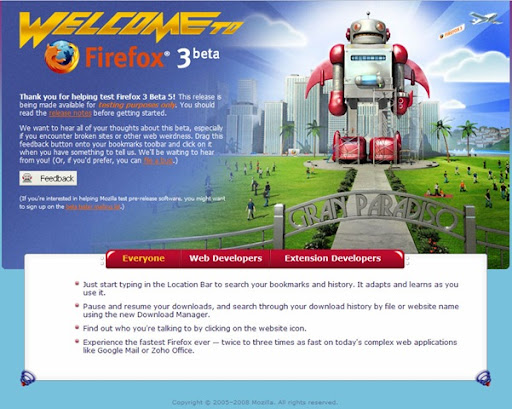
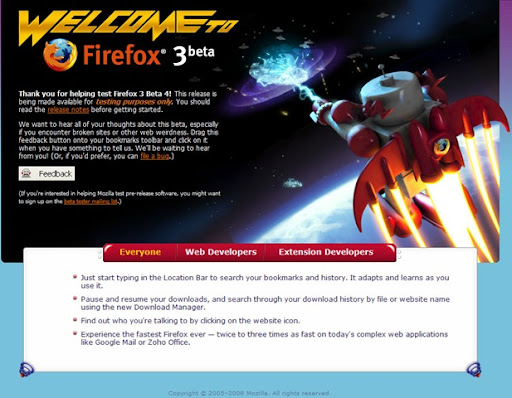
Mozilla has been playing a lot lately with Firefox 3 and has been running this marketing of a robot image that's protecting the world. The what's new from the latest Firefox 3 beta 5 has the Robot in a park. Other ones from Beta 4 also features something like this.. (see below)

Mozillabeta5 Mozillabeta4

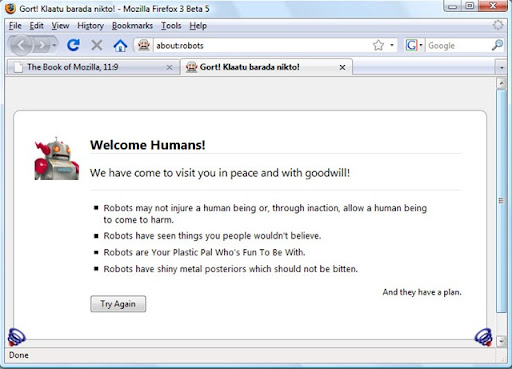
Continuing the rounds of fun that they are having there are few more robot things inside latest Firefox 3 Beta 5. Type about:robots in the address bar and you'll see a nice fun thing about robots and how they welcome you. Watch the screenshot below:

Mozilla-Robot

And another good thing is that Mozilla is also in the midst of making a "Book of the Testament". If the old Testament had Book of Samuels, Book of Kings... then Mozilla is creating a new Book of Mozilla. They are expecting it to be the web surfers holy grail. Type about:mozilla in your address bar or see the screenshot below.

Mozilla-Book

There are few more things to be discovered in Firefox 3. Few more lands to be conquered. If you have the Columbus in you, go find America!!

Sunday, March 30, 2008

Webkit Winning in Dromaeo - Mozilla's JavaScript Benchmark

Benchmarking is always an interesting topic of debate and especially when you have a cult-feeling around a product, it fun to watch. With the Race to ACID3 over, there is another hot topic of discussion going on in the world of web browsers. And it's JavaScript that is in question. Dromaeo is Mozilla's JavaScript Benchmark Test and I happen to put all the popular browsers on the burner!

JavaScript is an important component in today's web. It's used all over the web and is de-facto standard for browser-side execution. It's used through a lot of frameworks like YUI, Prototype, Dojo, jQuery etc. And then there is AJAX, which uses JavaScript at its base. Thus, when you compare browsers, checking the JavaScript performance makes some sense.

Dromaeo

There are a few popular ones for testing JavaScript performance. Infact, you could even write a few of your own and test, but I would recommend one of the popular ones that try to replicate real-world experiences. There is the popular JavaScript test from Webkit called SunSpider. You can find a good comparison of the browsers on that test at CyberNet. I found Mozilla's Dromaeo to be another benchmark which seems to do a lot of things like you would do in the real-world. The following are the browser results from the benchmark.

Browser (version + build) Total Time for Test (click on the timings for detail)
Safari nighly (Webkit r31368) 1805.40ms (Total)
Firefox 3 pre-beta 5 (2008032005) 1855.20ms (Total)
Safari 3.1 (525.13) 2000.80ms (Total)
Opera 9 Beta (WinGogi: build 636) 2625.00ms (Total)
Opera 9.26 (build 8835) 4158.80ms (Total)
Firefox 2.0.0.13 (release) 7897.40ms (Total)
Internet Explorer 7 (7.0.6001.18000) Unknown (didn't have the patience)

Note: Your results may vary due to various reasons, but the ranking would nearly (tough one between WebKit & FF3) be the same.

IE7 had a hard time completing the benchmark (I couldn't wait for it to complete) and as the Mozilla Wiki on the test mentions, it is a problem with IE7. I couldn't do the test on Konqueror as my Linux box has some issues booting up.

Among other things, the test goes to show the performance increase in Firefox 3. Thus, it is the right time for Mozilla to publicize the improvement in JavaScript performance and thus, I guess they have released this benchmark. Webkit and Firefox 3 are pretty much on the heels of each other in this test. Firefox 3 has also made some progress on decreasing the memory it uses when lots of tabs are open. This should give the Mozilla team something to cheer about after they said sour grapes with not participating in the ACID3 race.

Friday, March 21, 2008

Firefox 3 Beta 5 Out. Last One Before the Final

The Mozilla team has code frozen and baked (some irony: frozen-baked) Firefox 3 and according to talks, it as stable as anything out there. Mozilla says Firefox 3 is ready for prime time and the last beta is out for download. Get it from here.

The entire thing from now on can be watched and tracked here for all the interested people. Firefox 3 is really doing pretty well in terms of stability and there are really very few major bugs left to iron out. If everything goes fine then on 27th March we can have the final of Firefox 3 hit the web.

Its still called Minefield, as you can see from the icon I've put up. But I haven't stepped on a mine yet and it seems good to go !!

Saturday, March 8, 2008

Download Firefox 4 & Give Feedback

While everyone has got into the race for ACID3, the guys from Firefox team have released Firefox 4 (aka MineField) in pre-Alpha stage of development. If you want to have a look at the future of Firefox, then download the pre-alpha from here and give your valuable feedback to the Mozilla Dev Team.

Although the site warns you:

Warning: This is NOT A FINAL OR PRE-RELEASE VERSION. This program is provided without any guarantees of stability, so please use it at your own risk. It is recommended that you back up your profile regularly, as there may be bugs that corrupt your data. If that sounds scary, you'd probably be better off with the latest version of Firefox

Trunk builds change every hour of every day. Some of the major changes in these builds that require feedback are:

  • Changes to the graphics layer
  • New data storage layer for bookmarks and history (using SQLite)
  • Extended search plugin format
  • Updates to the extension system to provide enhanced security and to allow for easier localization of extensions
  • Support for SVG text using svg:textPath
  • To get a list of the most recent additions, check out the Burning Edge weblog.

I like the new Bookmark system that MineField brings. It is more easier to manage when you have a lot of bookmarks. The address bar also has a new feature where it shows a lot of links automatically from the current page. This feature does help you when you can't remember that webpage you recently visited.

With Firefox 3, still not released as a final build, it seems odd that Minefield build has been released. I guess the developers want to start making Firefox 4 complaint with ACID3 and want everyone to look at it. It does score 67% on the ACID3...