Showing posts with label India glorified. Show all posts

Monday, August 16, 2010

$35 Indian Tablet Vs Dell Streak

Sagar, a friend of mine has been pushing me news about the new $35 laptop from the Indian HRD Ministry… And I’ve been saying it’s one of the false promises that politicians are known to make. Nothing good comes out of these news flashes. On the other hand, we also have another device that Dell is preparing to launch known as Dell Streak. These two devices have a lot in common, but are also quite different in the markets they are targeted for and obviously the price.

Now the Indian $35 Laptop:

  • Processor / Chipset still unknown
  • 7-inch resistive touch screen display
  • Capable of browsing the web
  • 2GB of RAM
  • Wi-Fi connectivity
  • USB port
  • VGA camera on the back
  • Interestingly the software or the operating systems seem to be different in different demos. Some recent demos are showing an Android operating system, while the initial demos of the device seemed to have Meego installed on it. The device is still a year away from availability, but having seen it run and that too pretty smoothly for such a cheap device on Android, I am very pleasantly surprised. No technology in recent years has blown my imagination like this one… and if it can be mass produced with excellent software, this is the tablet that the world’s poor children were waiting. Understanding some of the challenges of such devices, I do not believe the tablet is still there. But it is definitely a leap forward…

    Dell Streak:

    The Dell Streak is another tablet device running the Android operating system. The Dell Streak is costing $550 and is available with a contract from AT&T at $300.

  • 1Ghz Snapdragon ARM processor from Qualcomm
  • 5-inch capacitive multi-touch WVGA
  • 5 MP autofocus camera on back
  • VGA camera on the front
  • 512MB RAM
  • 3G + Wi-Fi support
  • GPS
  • Accelerometer
  • Streak is pretty expensive when you compare it feature-wise to the Indian tablet. Obviously the market and the margins are different, but just goes to show the line between phones and tablets is blurring. As Android becomes more prevalent in the market, the line becomes more blurred. As realized in Meego, the combination of Maemo (Nokia) and Moblin (Intel-Linux) turns out to be very powerful smartphone OS. Although these devices are great, it is the applications that make the user-experience special and make these useful.

    As the Indian tablet progresses forward, the acceptance of the device are going to be determined by the applications that run on the device. If they are targeted towards children between the ages (6-12), it is going to be very interesting to build applications for them. Where education and knowledge can be taken to new limits, the true potential of such devices also depend on how they are delivered.

    Friday, November 14, 2008

    Indian Flag on the Moon

    It is a glorious moment for Indian Space Research Organization (ISRO) and India, for it has become the 4th country to have landed on the moon. Today, just hours back Chandrayaan-1's Moon Impact Probe (MIP) landed on the moon's surface and carries the Indian flag to the moon's surface.

    India becomes the fourth country along with US, Russia and European Union (not really a country ;-)) to reach the surface of the moon. The 35-kg MIP hit the moon's surface at 21:31hrs after it was lauched 25mins earlier from Chandrayaan-1, which is currently orbitting the moon and sending images of the moon's surface to ISRO. The MIP is one of the 11 probe that Chandrayaan-1 is carrying for various exploration activities on the moon. According to ISRO officials, the MIP landing was perfect and worked exactly as planned.

    After the landing, ISRO chairman G Madhavan Nair said, "The Moon was favourable to us. We have travelled all the way to the Moon. We have given Moon to India". It is indeed one of the greatest scientific achievements in India's history and everyone is elated...

    I'm not quite sure how India received the moon with this mission, as quoted by the elated chief. I thought the white disk that I've been looking at since childhood was the moon ;-) and its been in view from India for centuries!! Next time when I look through a telescope on the moon's surface, I'll try to find the Indian flag!! Anyways, now we are all waiting for India's manned mission to the moon which has become somewhat of a race with China's moon mission.

    Friday, August 15, 2008

    Indian Sues Google, Yahoo & Microsoft For Sex-Selection Ads

    While India is celebrating its 61st Independence Day today, among other problems, Gender Inequality and Gender Imbalance is a major problem for the future of  India. And somewhere between the lines of the so-called non-intrusive ads that you see on web pages, techniques for sex-selection for an unborn child is being promoted. Or so thinks Sabu Mathew George, the petitioner in a case filed in Supreme Court of India against web advertising and search companies like Google, Yahoo and Microsoft.

    Gender Imbalance is a major problem that faces India in the next few decades. Although the Indian society at large is still unaware of the problem, from the google-evilstatistics and ground work that I’ve seen while working with Men Against Violence & Abuse, the problem is a severe one and could become adverse in the coming decades. Gender Imbalance is a man-made phenomenon in India where an unborn child’s sex is determined before birth and if the child is a female, the pregnancy is aborted. It is this ruthless murder of unborn females that in some states the sex ratio for males to females is less than 0.7

    But that is not what we are here to talk. Sabu Mathew George has filed a petition in the Supreme Court of India that certain ads displayed on search results and web advertise the process of sex-selection. The Supreme Court has sent notices in this regard to Google, Yahoo and Microsoft in this regard and would like to hear their side of the story. The Indian law’s on Pre-conception and Pre-natal Diagnostic Techniques Act. states that advertisement of products and techniques to aid in the selection of an unborn child's sex is an offense. Thus, advertisement of such products are not shown in Print-media,  TV and Radio ads.

    India’s Health Ministry and Ministry of Communications & IT have also been made respondents in the case because they have been non-responsive in stopping such ads. It should be interesting to see how these tech companies respond. If you look at it from a technical standpoint, such ads could have been easily spotted and not shown by these companies. There is already a procedure by which the content in ads is checked by these companies and can prevent such ads to be shown. Even the search results are moderated according to local laws and standards and it isn’t uncommon that the Chinese government have successfully changed the behavior of these companies.

    May be these tech companies haven’t realized the magnitude of the problem or just ignored the law. But we are surely going to find out, if the Supreme Court holds them liable for such instances. Or can web companies just say that they are mediators and not content owners and get away.

    Google had earlier stated in its Public Policy Blog that, “Think about the telephone system. We don't hold the telephone company liable when two callers use the phone lines to plan a crime. For the same reasons, it's a fundamental principle of the Internet that you don't blame the neutral intermediaries for the actions of their customers. Rather, the standard recognized worldwide is that Internet intermediaries are responsible to take action when they are put on notice of unlawful content through proper legal channels.”

    Now that’s as awful analogy!! Telephone system is a one-to-one or conference system, where you don’t have your comments recorded for the entire world to look at. Neither can it be technically feasible nor morally acceptable to hear every call being made. Whereas content on the Internet, that is displayed as search results can very well be observed and banned, like has been done in China. In India, you have laws to stop it in other forms of media, then why should the Internet be any different?? There are obvious “report abuse” links to results and web displayed content. But the utter slowness in the response of such services is another reason why the system needs to be fixed on both the government side, tech-side and the users-side.

    Monday, April 28, 2008

    India Overtakes US For Mobiles, But Broadband Sucks

    The Telecom Regulatory Authority of India (TRAI) released the latest figures on the number of subscribers using wireless network in India. According to the press release, India became the 2nd largest wireless network in the world, overtaking US and 2nd only to China. India has 261.09 million wireless subscribers and most of these are mobile phone users (GSM, CDMA and WLL).

    • India becomes second largest wireless network in the world.
    • 10.16 million Wireless Subscribers added in March 2008
    • Subscribers base touched 300 million mark.

    Mobile subscribers have been increasing at an exponential rate for sometime now and this was expected. Mobile voice services are pretty good across India and a lot of cities, towns, villages are under coverage area. But something needs to be done quickly about the data services. Wireless data services suck completely and WiMax is just starting to catchup with Reliance and TataIndicom boxing each other. The service quality for WiMax in cities is still below par and services needs to improve.

    According to the TRAI figures, broadband users are at 3.90 million at the end of March. If you look at the figures, you'll realize broadband penetration is really really low. Even the growth rate is pretty slow... There are a few reasons to this and the poll at Trak.In shows some reasons. But I guess its a little more complex than what the poll shows.

    Reasons for Low Broadband Penetration:

    1. Illiteracy & Lack of Computer Knowledge: I think this is the primary reason why broadband penetration is low compared to mobile phone usage. You don't need much skills to talk on phone, but operating a computer and browsing the Internet is not as simple. It is partly to do with illiteracy in India, but as a programmer I can only believe that we need to make the User-Interface on the computer lot more intuitive. I feel really bad when I see new users struggle to use the computer and probably we need to improve the interface quite a bit.
    2. Expensive Broadband: The entry-level broadband service in India is really not very costly. Its only that its costly in the long run because you have very few plans where you can get unlimited data download/upload. As soon as you realize the Internet is a big place, you already have downloaded too much and pockets start feeling lighter.
    3. Poor Quality of Broadband Services: The downtime, low data speeds, big repair time, too much time to provide a connection are probably only adding to the problem of high cost.
    4. Few Useful Online Services: Although this is changing slowly, there isn't much local stuff that you can do online. There isn't a online retailer like Amazon or useful online services like Pizza shops, cafe or Online hardware stores. Online banking and travel booking is popular, but still is far from mass market.

    Actually it is a circle of things. The online services will improve if more people come online and more people will come online if there are useful services. Hopefully soon, one of these will improve and accelerate the growth of the other...

    Tuesday, November 13, 2007

    India's Tata Owns Asia's Fastest Supercomputer

    Guest Blogger: Steven Parker
    13th Nov, New York

    I know a lot of the reader's at this blog are Indians and this one is for all the Indians to make you feel proud. Tata Group, which is India's popular conglomerate own the fastest supercomputer in Asia and the 4th fastest in the world. The supercomputer called "Eka" (One) is located at the Computational Research Laboratories (CRL) in Pune, a wholly owned subsidiary of Tata Sons.

    The rankings were announced yesterday at the Supercomputing Conference held at Reno, NV. The list can be found here in all its glory. Its is the first time that a supercomputer from India has figured in the top 10 list of supercomputers. Eka is built by HP and uses Cluster Platform 3000 BL460c, Xeon 53xx 3GHz, Infiniband. It reaches a max of 117.9 TFlops and Rpeak of 170TFlops. It moved from its earlier ranking of 179 to rank 4, and is quite a big achievement. It cost the Tata's $30 million to build. Tata's announcement can be found here about the entire thing.

    I do not agree with Sunny's view of using GPUs for supercomputing. The cost of the hardware would come down considerably, but the cost of software would be a lot higher considering the productivity of programming the GPU. Let's see how this one turns out!

    Saturday, October 13, 2007

    Tata Indicom Launches 1Mbps Unlimited Plan

    A few days back saw a CNN/IBN report, about the woes of a Tata Indicom customer. Big downtimes, slow browsing speed, bad customer suppor etc... I have found their service pretty good at a few places and their wireless datacard seems to be pretty good in Mumbai.

    Just found out just now that Tata Indicom have launched their 1Mbps Unlimited Plan. In India, broadband is just about high-speeds with data caps and you have 2Mbps plans with a download limit of 1Gb a month. Its like giving someone a F1 car, but then limiting the speed to 20km/hr.

    But Tata Indicom plans to change that. They have started something which other ISP have not even thought of. 512Kbps plans are also such a rare thing in India, that giving a 1Mbps unlimited connection is unthinkable. They will be charging Rs. 3600/- a month, which seems to be quite a lot, but atleast its a start. As time goes on, I think we will have other companies with similar plans and the price will go down then!! Good work Tata Indicom/VSNL... Just take care of the service now...

    Monday, September 24, 2007

    The Future For Amit Paul - Indian Idol

    Since I've got the highest comments on a post about Amit Paul, I thought let me forget the technical discussion for this another post...

    Amit Paul didn't win the Indian Idol 3 ... So what?? Just got hot news from Amit's side that he's coming to Mumbai. Today at 3 pm, Amit along with his family came to Mumbai with the 4 judges of the Indian Idol. A lot of audience who watch the show know that Amit was the favorite of the judges. Amit will be signing playback for 4 films with Javed Akhtar and Anu Malik and others. So cheerup!! Amit will be going to Shillong, his hometown in Meghalaya in 4 days. He'll be performing there one more time for all his supporters.

    In Mumbai, he's been gifted a flat and has been offered Rs.10 crore contract by a few people of the music industry. So we all know that Amit will be back!! Another observation that I made was that Amit was gifted the Maruti SX4, eventhough he did not win! So he's got a lot of people who love his voice!!

    Personally, India has a lot of talent and enough audience for each talent. So let's support whomever you love and enjoy good music!!

    Sunday, September 23, 2007

    Google Transliteration: Write Hindi In English

    Yeah, you heard me right!! You can type English alphabets and get corresponding Hindi text. Its called transliteration and should not be mixed with translation. Translation in this case would mean, finding a Hindi word which has the same meaning as an English word, whereas transliteration means, finding a Hindi word which sounds like the English word. Go here if you wish to play (and work) with Google's Indic Transliteration Web Application.

    Google released this application for Indians to play with about a month back, and I saw it about 2 days after launch. But a lot of people who use other indian language typing softwares, still don't know about it. I thought this post will help them, since I find this application extremely useful and use it quite often!! Congratulations & praise to Google for making this application. Its really not easy to make such an application, and it works nearly perfectly. And they gave it free!! Dont we all love google for their free stuff !!??

    The good part about this application is that you can copy-paste the output to any html file. It really can't get any simpler than this. No copying fonts, no complex software, no clicking on an on-screen keyboard, just type and see the output. For me its a winner application and I see in my blogger account that Google is using the same application with blogger as well. Its a javascript that they are using to render into the textarea. So its simple to import into any other application Google wishes to.

    PS: Does anyone know if you can use this javascript in your own webpage or application?? (With Google's permission obviously). I've tried the FAQ as well as had a hard time trying to understand the Google TOS.

    Wimax May Not Be The Future Broadband For India

    The Ministry of Communications and Information Technology of India declared 2007 as the year of broadband internet and promised broadband access to majority of Indians. BSNL played a major role as a government company to fulfill this promise. It started 2Mbps plans at a value price and this led private players to become more competitive. But all this is history!!

    Scenario:
    India has cleared the spectrum for Wimax (read more on Wimax) and it seems India is banking on Wimax to reach its 20million target by 2010. But the problem is not in the technology for Wimax. Its an excellent long range and efficient wireless internet technology. It has coverage of 30miles from the tower and offers speed as much as ADSL modems provide.

    The problem:
    Broadband in India is very different from countries like US, U.K, Japan. In these countries, broadband access means unlimited downloads and faster access needed for video streaming and conferencing. But in India, unlimited data usage is something that's unavailable at higher speeds. No ISP provides unlimited access at speeds of 512Kbps at an acceptable price. There are night unlimited plans (8-10hrs), but then what about the day time?? Hathway's (a DOCSIS cable ISP) in Mumbai provides night unlimited at 512Kbps, but with a lot of users using this plan, speeds have dropped to less than 128Kbps during the night hours. Its been close to 2 months now that the speeds have dropped, so it seems unless someone sues Hathway for slow speeds, they are not going to buy some more bandwidth for its users.

    Without unlimited data connection does broadband make sense?? Yes, it does for people who access in the internet for a short duration and want quick work done. But for the majority, the speed improvement means more work can be done. So any broadband connection should mean unlimited data usage atleast at 512Kbps speeds. If you don't think its required, try viewing 10 youtube videos per day, and you'll realize how much data access you need.

    Even if Wimax is deployed by major ISPs, the biggest hinderance is going to be price and data usage. There are very less chances that Wimax will be cheaper in cities where already the ISPs have invested in wired networks. The major application for Wimax should be in places where wired network hasn't been laid down or where its costlier to maintain wired networks. But, for its success UNLIMITED DATA access is of utmost importance!!

    Sunday, September 16, 2007

    Two Solutions To Save Ram Setu

    Recently I have read comments here and here regarding the debate on Ram Setu or Adam's Bridge. Historians from all around the world are debating now, if the Ram Setu is a man-made (ape-made) structure or has it been naturally made. Whatever it may be, man-made or otherwise, it has sentiments of hindus and Indian culture intervowen with it. Ramayan is a prevalent story (history) across not only India, but across countries like Indonesia, Myanmar, Thailand, Cambodia, SriLanka and many other countries from South-East Asia. So, it is never a good idea to question someone's faith and especially not when you have so many people in a belief.

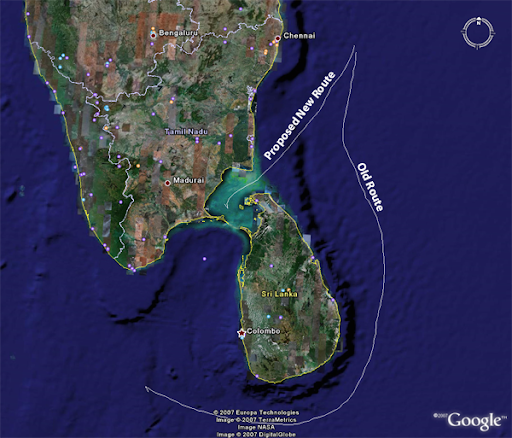
    People who do not know what the Sethusamudaram Project that the government has proposed is, this explanation is for them. Currently ships traveling from the East coast of India to the West Coast have to travel across Srilanka (see figure below). The Government of Tamil Nadu and the Government of India proposes a new route which will decrease the travel time by 10-30 hrs. For this the ocean has to be dredged and the total cost of the project is Rs 2,427. So there's a development issue to it as well. The project will save on the costs of travel as well as improve navigation. So the big issue today is should faith/belief/religion come in between progress/technological development??

    Map1


    My idea is that we should find an in-between solution to the problem. Most of the debate happening around the world is not resulting in a solution. So, I thought how about giving out 2 solutions that can be implemented in this case.


    The First Solution (Easiest and Cheapest):
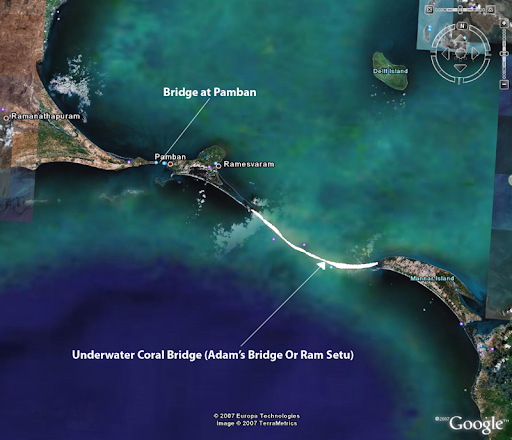
    We already have a land bridge between Pamban island which is used by cars to travel from Ramanathapuram to Rameshwaram. The height of this bridge should be increased, so that ships can travel from below this bridge. Additional dredging needs to be done across the sea bed, but it would be cheaper and easier compared to dredging the whole area near the Ram Setu.(see figure below). There are few examples around the world where such things have been done before, so shouldn't be a technical problem.

    Map2


    The Second Solution: (An Engineering feat to make India Proud)

    India could build a canal bridge, something like done in Germany at Wasserstrassenkreuz. India has to build a similar bridge over the Ram Setu and it could be a great engineering feat. It would be a little costly, but India could take toll on the travel of ships for the maintenance of this bridge. It will be great achievement if India could pull this one off. The bridge can be 3km long since the width of the Ram Setu is less than a few hundred meters. The sea surface is not very deep and hence building such a thing will be easy. The Panama Canal and Suez Canal's architecture for water logging could be used to fill the bridge with water. (View the bridge here)

    I have just proposed 2 solutions to this issue. There are many more solutions to the problem. Please leave your comments if you have any other solutions. Also, it would make many Indians happy if politicians could provide solutions rather than make noise on the issue.

    Monday, September 10, 2007

    TIFR scientists create Bose-Einstein Condensate

    Researchers at the Tata Institute of Fundamental Research (TIFR), Mumbai-India have created Bose-Einstein Condensate for the first-time in India. Bose-Einstein Condensate (BEC) is referred to as the 5th state of matter and was first proposed by India scientist Satyendranath Bose and later worked on by Albert Einstein in 1925. The irony of this latest creation in someway is that although it was proposed by an Indian scientist, it took about 82years to be practically demonstrated in India. Scientists Eric Cornell and Carl Wieman from the University of Colorado at Boulder NIST created the BEC for the first time in 1995 and were awarded the Nobel prize for physics in 2001 with scientist of MIT.

    But this great achievement in India is no mean task. Very few researchers from around the world have been able to create it. The Phd. students Saptarishi Chaudhury (my first name rocks!!) and Sanjunkta Roy along with Prof. CS Unnikrishnan were involved in this development and we should congratulate them that Satyendranath Bose's soul would be very proud of them today. Some of their initial research papers are as old as 2005 and shows the amount of hard work they have done to achieve this extraordinary feat.
    Check out their personal homepages (by clicking on their names above) for their personal research and resumes. Their team page is here

    From their earlier abstract on MOT:

    Design, construction and characterization of a source of intense, cold and tunable neutral atomic beam will be discussed. These atoms are then captured and further cooled in a high-density Magneto-Optical trap (MOT), making the system a favourable starting point for production of Bose-Einstein condensate in an all optical dipole trap. In this talk we shall present the general principles and experimental techniques to trap and cool tens of billions of atoms to micro-Kelvin temperature using appropriate laser light and magnetic field. At these ultra-low temperatures, several routes to precision experiments using neutral atoms open up. For example, novel experiments to study quantum electrodynamics of atoms strongly coupled to cavities are possible and atom-surface and atom-cavity interactions can be studied in a near ideal condition. As a specific example, we shall discuss behaviour of cold atoms moving through a high-finesse cavity. Quantum degeneracy and atomic Bose-Einstein condensates are produced starting from a cloud of ultra-cold atoms in a MOT. These cold atoms can also be trapped in a micro-optical lattice, making it possible to do quantum measurements on single atom. This talk is meant to be a general introduction to the topic of Laser Cooling and Trapping of Neutral Atoms along with a brief description of a state-of-the-art experimental set-up built here facilitating high precision experiments.

    The scientists used lasers to cool atoms of Rubidium to temperature nearing absolute zero to create the BEC. The result is a superconductive material which in the future may be applied to fields of nanotechnology. Read here, the press release given to Press Trust Of India