Showing posts with label research. Show all posts

Wednesday, January 30, 2013

CFP: Theory-driven Interventions in Health care using Health Information Systems

Calls for Papers (special): International Journal of User-Driven Healthcare (IJUDH)
Special Issue On: Theory-driven Interventions in Health care using Health Information Systems

Submission Due Date
2/1/2013 (Extended to 1st March, 2013)

Guest Editors
Saptarshi Purkayastha, Norwegian University of Science and Technology, Norway
Knut Staring, University of Oslo, Norway

Introduction
Theory-driven evaluation came to prominence only a few decades ago with the appearance of Chen’s 1990 book Theory-Driven Evaluations. Since that time, the approach has attracted many supporters as well as detractors. At its core, theory-driven evaluation has two vital components, one conceptual, one empirical. Conceptually, theory-driven evaluations should explicate a program theory or model. Empirically, theory-driven evaluations seek to investigate how programs cause intended or observed outcomes.
Yet, limiting theory to evaluations is somewhat futile, because usually some theory as basis for a “hypothesis” (unless the research is using a grounded approach) is what drives interventions in the first place. For instance, some health information system (HIS) interventions aim to provide information about health system practices towards meeting the Millennium Development Goals (MDGs). A great number of theoretical lenses drive Information Systems (IS) interventions, and there have been attempts at collecting overviews of such theories, e.g., http://istheory.byu.edu. However, even though that list is quite comprehensive, it is not exhaustive – for example, it leaves out important perspectives from design science and information infrastructure theory.
In this special issue we seek to showcase papers that are driven by theory – in planning, in action, in diagnosis and in evaluations. Theory-driven interventions is used here to distinguish from report-style papers, position papers or papers that draw concepts purely from observations without theoretical basis prior to intervention.

Objective
The special issue would like to highlight studies in HIS that focus on doing IS interventions with a theory in mind or with knowledge building/testing in mind. The studies in the special issue would like to explain the phenomenon of IS intervention through IS theory, yet allow medical researchers/practitioners to connect with them. These studies will help medical informaticians or public health practitioners to realize the importance of existing abstracted knowledge (theory) and consider appropriate theoretical lenses for HIS interventions.

Recommended Topics
Suggested topics for discussion include (but are not limited to) the following:
- Participatory action-research as a bottom up strategy to problem solving and achieving change in healthcare
- Distinguishing end-users from super-users and theorizing their views in HIS
- Institutionalization of IS within healthcare practices
- Design science perspectives on HIS
- Interventions that deal with structures in health systems and their evolution
- Efforts at scaling interventions and information infrastructure
- Quantity of knowledge absorption, quantity of knowledge transfer, innovation in HIS
- User satisfaction, performance, perception, behaviour, usage as in Cognitive dissonance theory
- Dynamics of social construction and performance of illness through user-driven healthcare practices
- Capabilities, absorptive capacity, environmental turbulence, agility as in Dynamic Capabilities Theory
- Resource Importance, Alternatives, Discretion as in Resource Dependency Theory
- Speech acts, Communicative action as in Language Action Perspectives when HIS systems capture patient narratives or clinician notes or communication in health systems
- Fit-Viability Model of IS interventions on Health systems
- Bridging the gap between what we know and what is knowable in clinical practice

Submission Procedure
Researchers and practitioners are invited to submit papers (over email to the guest editors) for this special theme issue on or before March 1, 2013. All submissions must be original and should not be under review by another publication. Interested authors should consult the journal’s guidelines for the manuscript submissions at: http://www.igi-global.com/Files/AuthorEditor/guidelinessubmission.pdf. Submitted papers should not be more than 8000 words inclusive of abstract, tables and references. All submitted papers will be reviewed by 2 reviewers on a double-blind basis. Papers must follow APA style for reference citations.

We also request interested authors to send an abstract as soon as possible for discussion.
All submissions and inquiries should be directed to the attention of:

Saptarshi Purkayastha Knut Staring
Norwegian University of Science & Technology University of Oslo, Norway
E-mail: saptarsp (at) idi<dot>ntnu.no E-mail: knutst (at) ifi<dot>uio.no

Saturday, January 7, 2012

EMR at JSS Bilaspur – In pursuit of happyness

Over the last 3yrs, I have travelled across the world and looked at 100+ health facilities of different scales. My last encounter with a health facility in rural Bilaspur was very different. Having looked at systems of practice in a variety of health facilities including subcenters, private clinics, primary health centers, community health centers, district hospitals, tertiary hospitals and super-specialty hospitals, each of these places have different characteristics. What makes Jan Swasthya Sahyog (JSS), situated in rural Bilaspur in Chattisgarh special is the motivation levels among all the staff at the health facility. This includes clinicians, nurses, technicians and computer operators… And the motivation of these people stems from the fact that they still believe in care, rather than just providing health services. I use “still” because in my worldview of health facilities, most often I see people missing out on the “care” from the notion of health-care.

My visit to JSS was for volunteer work that I have been doing over the last few months to see an Electronic Medical Record (EMR) system to be setup at JSS. Over 100 volunteers across the world have come together in this pursuit to build an EMR system that is easy to use, suited to low-resource settings and can help improve work of the providers as well as help provide better services to patients. JSS was founded 15yrs back by post-graduates doctors of All India Institute of Medical Sciences (AIIMS), India’s most prestigious medical school and hospital to provide healthcare to people who are deprived from it because of poverty, neglect and lack of development. And when I visited JSS on Christmas 2011, I could see the savior work done by JSS for the many people who come from far-flung places because they are treated with dignity and care.

The EMR system broadly from interviews and discussions with some doctors, nurses, other staff and my interpretation of the context needs to do the following:

  1. Help to improve efficiency in use of resources and providing patient care
  2. Help to maintain correct medical practices through validations
  3. Help to understand who, what, why is being treated at JSS

EMRs or for that matter any computerization process advertises many-fold benefits. Technology is most often considered the silver bullet that will solve all problems. From my experience this is rarely the case. So these 3 points might provide a guiding path to decisions that we make in the design of the EMR. In the design of the EMR, just like JSS we have to put “care” at the forefront of our efforts rather than technology prowess. Thus, this system is envisaged to be a point-of-care systems where providers will look up records and use the system to provide “care”.

The other very unique thing about JSS is that is it rooted in the locale of the context. Having seen other health facilities setup by “change-makers-coming-from-the-outside”, JSS is uniquely very much part of the context. This is one of the reasons I see why people come from more than 100kms away to JSS for treatment. People view JSS as locals and one among their own. This is one aspect that I think the EMR system should incorporate. It should embody in itself the locale. By locale, I mean the local practices, language, usability… among other things.

I would say we have some lofty goals for the EMR. One that the project lead calls as “Linux of EMRs”, but in my opinion even if we achieve more humble ends, like not causing burden to providers and patients that would make me happy. It is this pursuit that drives me to work towards this cause. I call it a pursuit because I realize this is not something that is a stagnant phenomenon. It will change with every small change that we make. Every morning it is this pursuit of happyness that drives me to understand what an EMR system would be of use at JSS.

Monday, March 7, 2011

Socio-materiality: Creating words for the heck of it

While last week, I was in NTNU, Trondheim for a friend’s PhD defense, I decided to stay back and listen to a seminar on “Socio-materiality”. The “jargon monoxide” (super lol!!) to describe that technology, work and organization cannot be viewed separately. We’ve definitely heard that human & non-humans are an assemblage and cannot be looked at separately... and I completely agree that academics deserve ridicule, when they do such things!!

Nonetheless, after the seminar I couldn’t believe that the whole 3hrs, we repeatedly kept hearing that technology changes social behavior and that in turns shapes technology and there is a case of “entanglement” that makes the social/human and material/technology to be only looked at as a single object. The cases were interesting (especially the case of Gartner and their Magic Quadrants) and in each of the case we see the entanglement and mutual shaping. What I still don’t understand is that why we didn’t have an uproar from the audience (… and those much more interested in the concept than me) to this jargon monoxide!!

As researchers we continuously look at ways in which we understand the things around us. Language is one to interpret, understand and communicate the different interpretations inside our head. My father shouts out while I’m writing this, “Research is only searching again and again, what already exists and is probably already known”. If that were true, then jargon monoxide is the basis of research… We create new jargons and retire old ones!! Is that our primary job??

Monday, January 5, 2009

Computers have life? Hard-disk reacts badly to screaming

When J.C Bose first proved that plants have life, he used a crescograph and showed that pleasant music or a friendly chat with plants helped them grow faster. On the other hand, plants didn't like someone shouting on them... Now, as weird as it sounds, computers (hard-disks) also don't like it when someone shouts at them.

This was experimentally verified by Brendan Gregg from Sun Microsystems Fishworks lab where they create loud noises around a JBOD disk array. Due to the vocal vibrations, there is a spike in the I/O operations and a clear increase in the disk latency. The finding is interesting because it can be useful to make datacenters quieter to improve performance. The finding was put on Youtube on 31st Dec, 2008 and you can look at the video below:

So with that video you realize that computers don't like someone screaming at them. Next-time when Windows hangs on you, don't shout, your PC will slow-down further!! May be it has some form of life ;-)

Wednesday, March 5, 2008

Microsoft's Next-Gen OS Research is Open-Source Now

Microsoft has been researching on operating systems for sometime now and manufacturers the most popular operating system in the form of Windows. But most of the research that goes into Windows is unknown to the rest of the world. Most people bash Microsoft of being very secretive and people from the open-source world often criticize Microsoft for this. But today Microsoft has done what many people believe is impossible. Microsoft has released their operating system research to be used in future as an open-source project. And the project is called Singularity.

The name Singularity does sound like some path-breaking theory in physics. In the world of operating systems, Microsoft's Singularity is sort of path-breaking. Microsoft announced Singularity about 2 years back and had started thinking about it 3 years before the announcement. After 5 years of research, today Microsoft released Singularity with source-code to codeplex, which is Microsoft's open-source community repository.

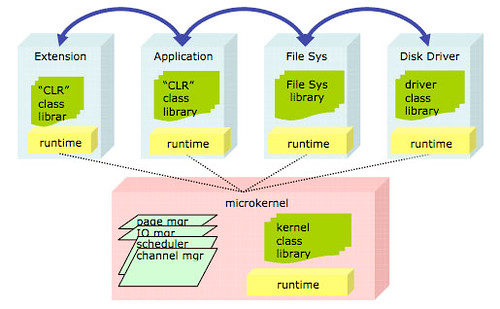
Singularity in theory looks to be very promising. It uses a microkernel architecture, which means the kernel is really very small and contains only very few services/managers. There was much long debate between Minix Vs Linux on microkernel Vs monolithic kernel without result. I side with Minix and this with PCs getting faster we need more stability than performance. But I guess that is part of a different discussion altogether. The following image shows the architecture of Singularity OS.


I have just finished downloading the Singularity RDK (Research Development Kit) from here, and will be installing it on Virtual PC.

Monday, February 4, 2008

Fourth Undersea Cable Cut - Conspiracy Or Doomsday

In what seems to be the next twist in the tale of events happening in the world of internet connectivity, another undersea cable has been cut after last week's 3 cable cuts in the Middle-East. According to the reports from ArabianNews, Qatar Telecom (Qtel) said on Sunday the cable was damaged between the Qatari island of Haloul and the UAE island of Das on Friday.

This fourth cable cut has affected the internet connectivity of Qatar only and UAE has been largely unaffected by this mishap. Earlier, there were suggestions and reports all around the world that the earlier cable cuts were due to the anchoring of a ship. But the latest news suggests that the place where the cable cuts had taken place is a prohibited area and ships cannot travel through that region.

Egypt's Minister of Communications issued a statement, "A marine transport committee investigated the traffic of ships in the area, 12 hours before and after the malfunction, where the cables are located to figure out the possibility of being cut by a passing vessel and found out there were no passing ships at that time,".

These confusing reports have resulted in conspiracy theories that these have been done by terrorist organizations. Some people have also suggested that the cable cuts are a way to move the attention away from the phone-tapping news in UK. Whatever be the reason, it seems extremely odd that 4 cables have been cut in a span of just 5 days. Is the doomsday for internet arriving??

Friday, February 1, 2008

Detailed Images - Find the Undersea Cable that affected 75million netizens

Its been 3 days since the undersea cable between India and Middle East got cut by a ship and according to some analysts about 75 million people got affected by the cable cut. The internet speeds across India and the Middle East was slow, but I personally haven't observed any speed drops on my connection. May be the global torrents have slowed down, but downloads from http/ftp and surfing speeds have been unaffected.

A Detailed Image of Undersea Internet Cables (courtesy Guardian & Telegeography: click for a larger image)

mid-east_cables

A gist of what everyone's reporting:

The Inquirer - Middle East loses internet

DailyTech - No YouTube for You

Reuters - Internet disrupted in Egypt and India

Trak.in - Internet Down

The latest reports suggest that there has been a third cable cut in the Middle-East known as the Falcon. But this won't affect the current traffic which is now being temporarily redirected through the older SeaMeWe-3 cable.

Monday, September 24, 2007

Peek Into What's Cooking At Google Research

Before anyone asks me, let me tell you that I'm not working for Google, nor am I a Google PR!! This series of posts on Google started after I got the comment about Google's history and how Google got its name. This post is to give you an idea about what are the different research going on in Google. I wrote last time that Google has slowed down on innovation. This may be true, but with Google's growing employee size, the people who are doign research after joining Google has also increased.

Few topics that I found interesting taking place at Google: (You can read the full list here):
  • Ad Hoc Distributed Simulations, Richard Fujimoto, Michael Hunter, Jason Sirichoke, Mahesh Palekar, Hoe Kim, Wonhu Suh, 21st International Workshop on Principles of Advanced and Distributed Simulation (PADS'07), 2007, pp. 15-24.

There are many more research papers which Google employees have recent in 2007. Infact in 2007, 125 publications were written, whereas in 2006, 113 were written. Some other popular research at Google on Data Management, that is used by Google in Google Maps, Gmail are Chubby, Google File System, MapReduce and BigTable.

If you like to know stuff in A/V, you can also watch videos on Tech Talk at Google Here.