Showing posts with label microprocessors. Show all posts

Sunday, September 18, 2011

Speeding up Unit Tests by running them in parallel

I just discovered an interesting parameter in the maven-surefire-plugin when using JUnit 4.7+, that tests can be executed in parallel. With multi-threaded CPUs, OS and the like, this helps a lot when you want to decrease the time of your test suites.

So, what are the configurations options that you have:
  1. Running test methods in parallel:
    <plugin>
    <groupId>org.apache.maven.plugins</groupId>
    <artifactId>maven-surefire-plugin</artifactId>
    <version>2.9</version>
    <configuration>
    <parallel>methods</parallel>
    </configuration>
    </plugin>

  2. Running test classes in parallel:
    <plugin>
    <groupId>org.apache.maven.plugins</groupId>
    <artifactId>maven-surefire-plugin</artifactId>
    <version>2.9</version>
    <configuration>
    <parallel>classes</parallel>
    </configuration>
    </plugin>

There are some things to take care when running unit tests in parallel. Some of them might not be independent, isolated and reproducible. There are times when you have some test methods that might depend on other methods in the test class. That time you should use the parallel test class execution. You may also want to tweak the number of threads and core on which these threads run, using this configuration:

<plugin>
<groupId>org.apache.maven.plugins</groupId>
<artifactId>maven-surefire-plugin</artifactId>
<version>2.9</version>
<configuration>
<parallel>methods</parallel>
<threadCount>4</threadCount>
<perCoreThreadCount>true</perCoreThreadCount>
</configuration>
</plugin>

Friday, December 24, 2010

Microsoft coming back to ARM

ARM, the processor manufacturer that powers 90% of the mobile phones, digital media and music players, hand-held game consoles, calculators and computer peripherals such as hard drives and routers is a super-power these days and Microsoft realizes this more than ever. That’s the reason why there is talk that Microsoft is going back to release a OS for the ARM processors.

Back in the old days of Windows NT 4.0, Microsoft has a release of Windows that ran on the ARM architecture, but due to pressure from Intel and the growing market of IBM-compatible PCs Microsoft stopped release OS running on ARM. Thus, Microsoft only released Windows for x86 architecture (…and sometimes for Itanium). Microsoft has had WindowsCE running on ARM, but it is not the Windows that is popularized. The latest buzz means that Windows 8, the next version of Windows will be able to run on ARM processors

The reason why this news is interesting is because Windows Mobile 7 was just released and is a different architecture than the desktop Windows. If this means anything, then it shows Microsoft’s idea that a common platform can be moved across different sizes of devices, similar to what Apple has been doing with the iPhoneOS, iPadOS, iPod Touch and OSX. The idea is that the OS can be stripped off services and run on smaller devices. Today as more and more devices became part of our lives, we want to have similar experiences on all these devices… probably through different interfaces, but want the way data is looked at through a common way. Especially as developers, it is frustrating that the same applications cannot be ported easily across processors and platforms. The web is definitely the future of data, but rich client applications are important for the experience and the browser is still not everything that the devices/PCs can do.

Hoping that we can move towards converging platforms… especially easy ways to port client applications across platforms

Monday, August 4, 2008

Intel Larrabee to Support Both DirectX and OpenGL

Intel has been showing presentations on Larrabee for sometime now, but hasn’t openly talked about what instructions it will understand, clock speeds or even intel_logo a hard launch date. For people who do not know, Larrabee is Intel’s attempt to integrate GPU with CPU and create GPGPU (General Purpose GPU) or computing through the use of graphics processing units. Intel today made it clear at Siggraph 2008 that Larrabee will support both DirectX and OpenGL for graphics processing.

Intel already has the highest market share in the GPU world, thanks to integrated graphics processors (IGP) in its chipset's sold with motherboards. But due to the dismal performance over the years of these IGP chipsets, no one ever considers these capable enough for mainstream gaming. Benchmarks have shown time and again that even the most basic discrete graphic cards can perform better than IGPs. With Larrabee, Intel has intentions to bring more computing/graphics power with lesser power requirements.

Larry Seiler, senior engineer in Intel's Visual Computing Group said that, Larrabee's consists of cores derived from Pentium processors and have added multithreading and 64-bit instructions. Each core consists of 256kb L2 cache and the first release of Larrabee will have 8 to 48 cores depending on the market segment. Larrabee also has advanced multi-core capabilities and uses a 1024 bits-wide, bi-directional ring network for fast, low latency communication between the cores.

The programming paradigm doesn’t change with Larrabee because it uses the same x86 instructions used by Intel’s current generation microprocessors. Also with DirectX and OpenGL support inside Larrabee it confirms that current generation games will also work fine. But without any mention of the performance improvement in graphics capabilities over current generation IGPs, I still have doubts whether Intel is actually competing with its own processors or with the GPU vendors like ATI (now AMD) and  NVidia. Larrabee does look solid on paper, but as we know papers do create a lot more hype than they can perform and Intel marketing does know how to play that game.

AMD also has been working on Fusion processor which will integrate AMD CPUs and ATI GPUs into one chip. NVidia on the other hand has create a new programming paradigm with CuDA, which tries to enable normal computer processing to NVidia’s GPU. Whichever company wins this GPGPU battle, we would like to see all of them fight on the same grounds and support existing standards. Today’s Larrabee announcement confirms that both the DirectX and OpenGL standards are followed and will allow current breed of games to run on the Larrabee.

Monday, July 14, 2008

Processor Errata to be Next Big Virus Exploit

Writing cross-platform viruses were nearly impossible earlier and hence a virus would mostly affect only Windows or Linux or OSX, but not all of these together.virus Most Linux/*nix/Mac users felt viruses were only for Windows users, because of underlying OS protection in Unix user access model was good enough. But all of it could change if malware was written for common hardware platform such as Microprocessors or BIOS or Hardware Firmware. Well known author and security researcher, Kris Kaspersky is going to demonstrate how to create malware for processor bugs at the Hack-In-The-Box Security Conference (HITB) to be held from 27th-30th Oct, 2008 at Malaysia.

Processors from Intel and AMD often contain bugs known as errata and generally the way to fix these bugs is by updating the BIOS or Firmware in motherboards. Nearly every generation of processor has these bugs and if these aren’t any major bug, then no one even knows of them in normal computer functioning. But in some special cases these bugs affect some computers or software being used, and that’s when these bugs come into the light. Like the recent TLB Errata in 1st generation Opteron (Barcelona) processors from AMD would corrupt data in certain situations.

Currently, there isn’t a truly generalized way to exploit processor bugs and requires some detailed understanding of hardware and software combination. Most processor manufacturers don’t even mention deep details on the bugs and hence exploring them is a little more tough. Kris Kaspersky has claims to have found some way using JavaScript to exploit these bugs. Also, JIT compilers from Java Virtual Machines may be used to uncover and exploit the bugs, according to the Abstract of the Presentation at HITB.

If Kris Kaspersky’s “Hacker Disassembling Uncovered: Powerful Techniques To Safeguard Your Programming” book is anything to go by, we may have excellent and easy example by which he demonstrates the exploits. It could easily be replicated and understood by hackers and worked upon for other bugs. Stopping such exploits would be tough not just for anti-virus makers, but also for Operating system patches. And even if some fix is released on the motherboard BIOS, it is generally not implemented by all motherboard manufacturers... And user ignorance towards these BIOS updates is not even worth mentioning! This could easily be one of the tough and complex security problems to have come up!

Sunday, July 13, 2008

Power 7 Will Be IBM’s Supercomputing King

This weekend I heard a few guys from IBM India getting really excited about the next-generation microprocessor called Power 7 which will be released in H1 2010. The Power 7 processor is still not a final design but nonetheless, it is turning out to be an awesome processor. IBM’s latest plans show that Power 7 will be a 8-core processor, clocked at anywhere between 3.6Ghz-4.0Ghz.

Power 7 is a completely new architecture and is being developed at Austin, Böblingen, Rochester Research Centers. There are rumors that Opteron and Power 7 may share a common socket, but that doesn’t seem to be the case in the current design of the processor. But I got hints that things on the socket front could be changed during the final few weeks.

Power 7 is also a multi-thread per core CPU and current designs suggest it can execute about 4 threads per core. It still isn’t running optimally at the moment, but the target is to achieve full performance on all the 4 threads. This still makes Sun’s Rock the multi-threading king in the next-generation of processors. But IBM is high on the number crunching game. Each Power 7 core will be 32GFlops and that means on a 8-cores it going to output at 256GFlops. That’s no mean achievement!

Unlike the Power 6, which had its main aim towards improving single-core performance and max clocked at 6Ghz in prototypes, the Power 7 is working towards a multi-core, multi-threaded processor. From Intel to Sun, everyone has realized the potential efficiency of multi-core design and IBM hopes to lead the pack with Power 7. And to become the winner of the lot, Power 7 will compete against Sun’s Rock (UltraSPARC T2 Processors), Intel’s Itanium and Xeon (Nehelam-based) to some extent as well as its friendly technology partner AMD’s Opteron. IBM’s main goal with Power 7 is at the High-Performance Computing markets and supercomputers, where IBM already rules the roost.

Supercomputer1 Supercomputer2

If you look for stats at Top500 Supercomputers from around the world, you’ll realize what I mean by IBM ruling the roost. IBM has lots of BlueGene machines that use the old PowerPC processors, but not many newer generation processors. The reason to this is two-fold. IBM’s last generation processor Power 6 and to some extent Power 5 isn’t very power efficient. Power 6 heats up quite a bit and would require massive engineering skills to bring 1000s of these chips together inside a supercomputer. On the other hand, IBM has plans to mix-match Power 7 and Cell microprocessors in future supercomputers. Cell processors are known to be good specialized FP units and matching it with Power 7, IBM hopes to reach more than 10 petaflop from a supercomputer.

Thursday, July 3, 2008

Solaris & Xeon Break Million Messages Per Second

Sun Microsystems today announced that it has collaborated with Intel to not only provide the best throughput performance to date by breaking the million-messages-per second barrier, but also the lowest available network latency on a 1Gb Ethernet. This performance output was generated on a new financial services benchmark known as Reuters Market Data System 6.0.3 (RMDS).

The Intel-based Sun Fire™ X4150 with Solaris 10 provided the top-notch results for the benchmark and it indeed is superlative performance to reach million-messages per second. And more importantly its done on standard network topology instead of stacked topology, which can improve scalability but comes at a cost. Doing it with standard 1Gb Ethernet is surely an achievement. The performance by the system is highly dependent on the hardware which Intel has engineered and Sun has built. But Solaris also has contributed to the improved performance. Solaris has the least latency in message passing and network performance on it is excellent.

Sun Microsystems CEO, Jonathan Schwartz applauded the new benchmark results and attributed much of it to Solaris. And he sure must be happy!! Sun Microsystems is very focused on Solaris/OpenSolaris these days with a lot of development work towards OpenSolaris. There is also a big PR machine running for openSolaris these days and some ol’ Netbeans guys have been moved to talk and explore the world on openSolaris. Sun Microsystems has got this target to make openSolaris big on the desktop with a distro-plan similar to Linux distros.

Congratulations to Sun on the new benchmark record!! It is definitely one of the strong forte for Sun to perform on the network, but the desktop move is a totally different ball-game. And why didn’t we have one of those largest hardware/microprocessor team from Sun make the system from UltraSPARC to perform that good instead of the Intel hardware ??

Monday, June 23, 2008

Niagara 3 Does 256-threads, But No Supercomputing ?

The Register claims to have learnt that the next version of Niagara processors from Sun Microsystems is going to be a 16-core and 16-thread/core processor. Sun-logo This means that the Niagara 3 will be doing 256 threads simultaneously. And we aren’t talking of some distant future plan, but Sun Microsystems will be releasing these processors in 2009.

If you did not know, Sun Microsystems has been selling the Niagara 2 processors which can run 64 threads simultaneously on 8-core processor. Niagara 2 is officially sold as UltraSPARC T2+ chips and has been the most successful processors from Sun’s lineup in recent years. Obviously with so many threads running simultaneously on a single chip means that the performance is screaming and is excellent value for money. There are 2 socket systems available as well as 4-socket systems with UltraSPARC T2+. Then there is also the Rock processors coming in 2009.

From what I heard 2 years back, UltraSPARC had the largest processor design team in the world. So it comes as no surprise that it has the best design and performance in multithreaded systems. They also open-sourced their older SPARC designs as part of OpenSPARC.net and have pledged to continue opensourcing the next-gen processors as well!!

But the sad thing is that UltraSPARC Tx processors haven’t been as big a hit in the HPC and supercomputer market. If you have a look at the list of top supercomputers for June 2008, you will realize that Sun Microsystems just figures once on the top 10. It features in the top 10 for Texas Advanced Computing Center at University of Texas and uses AMD’s Opteron processors and not UltraSPARC. In all of the 500 supercomputers, IBM rules the roost with 209 systems and HP comes second with 183 systems. IBM has been able to push POWER processors to build some awesome supercomputers whereas HP has taken Xeon and built powerful systems around it. Sun Microsystems on the other hand has just 4 supercomputer systems and all are with Opterons.

Most people would argue that single core performance proves to be more effective than multi-threaded performance in conventional supercomputer software and benchmarks. Processes are more common units of work than threads itself, but that’s where the overall system building plays its part. Like Seymour Cray has stated, “Anyone can build a fast CPU. The trick is to build a fast system.”

Friday, May 23, 2008

NVidia Wishes It Could Live Like Intel

Nvidia has been kicking quite a lot of mud on Intel. Recently, it started with Nvidia claiming the GPU is more important than the CPU, then it was calling nv-intel Larabee a powerpoint slide and then claiming that Intel is a monopoly that doesn't want anyone else in the market. But in reality, NVidia dreams to be at Intel's position and its been proved once again with NVidia buying Utah-based ray-tracing company RayScale.

If you've been following the discussion, or you read the above links, then you'll realize how pissed off the Nvidia CEO Jen-Hsun Huang has got with Intel. The reason for this anger is that Intel has been researching on architectures that are supposed to replace GPU (graphic cards) from computers. If Intel succeeds, it means Nvidia are without a market. Intel calls these next-gen processors that will be able to process graphics along with normal CPU operations as Larabee. AMD is also working on something similar called Fusion. NVidia on the other than doesn't have much to bet on. Although CUDA is starting to make GPUs do the work of CPUs, its way more steeper upgrade curve. Imagine porting all your normal Apps to CUDA vs Optimizing your games for a CPU that can show graphics.

With all that trouble knocking on Nvidia's doors, obviously you can't blame Jen-Hsun Huang for his anger. But today's buy of RayScale could point to what NVidia could do in the future. Intel has been pursuing a lot of research on Ray-tracing as a replacement for the vector processing that we see on today's graphic cards. Ray-tracing can be done on CPUs or Larabee/Fusion and could render images on screen, with more realistic lighting and shadow effects. Currently it takes a lot of processing, but it isn't too far from becoming mainstream once we have optimized processors. NVidia may be preparing for such a product and RayScale could be its software partner to move in that direction.

Nvidia also does not have the great fabs that Intel owns. Intel's strength is its production and NVidia really can't manufacture its own designs. Thus, if Nvidia even manages to create a killer GPU+CPU, how can it create enough of these for the entire world?? AMD on the other hand with their ATI buy can switch anywhere between a CPU+GPU or GPU+CPU... But haven't you heard: If you've got one leg in one boat and the other leg in another boat, you end up catching your groin!!

Wednesday, May 21, 2008

Intel HexaCore Dunnington at 2.66Ghz

Intel has taped out its six-core processor running at 2.66Ghz, which it plans to release sometime in Q4 2008. Intel's six-core processor is currently codenamed Xeon Dunnington has 3 dual-core processors stuck with each other and run as a single packaged processor. The processor will require a new socket to run. But the good news is that Intel is able to extract good speeds from it.

Dunnington is a reply to AMD's 3-core processors (TriCore), which AMD had initially thought to be value-for-money for the customers. Intel on the other hand has no plans to sell Dunnington's for cheap and will be sold only as server processors, under the Xeon brand. The Dunnington processors have a huge cache of 16MB, which should be very attractive for applications that run a lot of threads. Another news has it that, Dunnington will be running a single thread per core, and does not use HyperThreading (HT) technology.

The last time I met an Intel Design Engineer from Bangalore, I had heard that Intel was much impressed by Sun's designs in Rock or Niagara 2. Lots of concurrent threads on a core are very good on servers. Intel seems to going forward with the core-race at the moment, but I expect a switch to more threads on a core very soon!!

Friday, April 25, 2008

Will The "Sun" Shine With x86 ??

Latest news has it that Sun Microsystems has bought a struggling x86 chip manufacturing called Montalvo Systems. Montalvo is known to have been in talks with Sun for quite some time and there were long running rumours that Montavlo would be bought. When I heard the rumours, for the first-time I had thought it would be crazy for Sun to get into x86, but now it seems they have actually bought the company for a bargain buy of $5.5 million.

Monalvo Systems is a fabless startup funded through venture capital. It raised about $73 million from the venture capitals, but needed more $100 million lately. It still hasn't made any money and hence was denied the request for additional capital. In comes Sun Microsystems and gets a bargain buy!! Now if you are like me, then you would be wondering, why would Sun Microsystems buy an x86 chip design startup. Montalvo doesn't have the clients nor the SPARC designs. Sun Microsystems has over the years talked us into the greatness of the SPARC architecture and x86 manufacturing is really not its game. But so wasn't Sun's software business...

Popular belief has it that Sun Microsystem is going to use Montalvo's technology in its SPARC chips. Montalvo seems to have an excellent IP and chip design team which Sun was interested in. Sun Microsystems also has an amazing chip design team and probably its the human resources which has resulted in this deal.

If this buy is another completely new strategy from Jonathan, then it would be one to really watch out for. Lately, Sun has been selling x86 servers with AMD Opteron and you never know what Sun is upto after the ticker change... From JAVA to x86 can't be a more dramatic change than the last time.

Tuesday, April 8, 2008

AMD Launches New Processerr... GoHome'on

AMD has been struggling and much of it is because of bad execution and sitting on the laurels when it was winning in the CPU race. AMD's financial woes amd-phenom-logo featuring huge debt after ATI buy continues and in this hard time they do like corporates always do. But in AMD style of bad names, they released a new processerr called GoHome'on and like 'Athlon and Duron', its not going to be met well by the markets. Its basically a product to ask employees to leave the job and "Go Home!!"

AMD expects revenues for the quarter ending March 29 to drop approximately 15 per cent drop from previous quarter but up 22 per cent over 1Q 2007. Generally Q1 is not the best time for microprocessor business, but this story is longer than that... AMD has been struggling with the performance and Intel has been executing better than ever.

AMD announced that it will layoff about 10% of its current workforce starting mid-April and finish the entire procedure by Q3. This means after the exercise finishes, 1,650 AMD employees will be doing something else. The markets haven't taken the news well and AMD is down by more than 4%. In the meanwhile, Hector is still on the hotseat trying to convince it'll be good someday and his expected successor Dirk Mayer is optimistic.

AMD just a week ago was saying that the layoffs are rumours. And today it confirms that there will be layoffs. The financial results will be out on the 17th of April and probably the layoffs are to promise some expenditure cuts on AMD's part... Hopefully, we aren't loosing some good chip designer who would have created something to fight Intel... Or else we will see AMD just limping around behind Intel!!

Monday, April 7, 2008

Only Intel Marketing Can Sell At 1500% Margins

How many businesses can sell chips at 1500% margins?? I bet you won't believe to buy processors at that price even if you were in Zimbabwe's inflation... But that doesn't stop Intel to sell its upcoming Atom processors at those margins, if you were to believe TGDaily. TGDaily noted earlier that Intel produces these  small processors at $8 including packaging and shipping. And according to the latest pricelist, Intel hopes to sell these at $135!!

Atom is the upcoming generation of low-power processors meant for MID (Mobile Internet Devices) that come in really small packages. I noted earlier about how much noise Atom has been generating even though its not the best performing part out there. But according to Anand, it seems Atom is some special change in architecture that's gonna change the future of computing. May be Anand's seen that 'Crystal Ball' of the future, but it still got me wondering about the hype and the pricelist just added up to the hype.

The price list is as seen below:

- Atom Z500, 800 MHz clock speed, 512 KB L2 cache, FSB400, 0.65 watt TDP, $45 (including chipset)
- Atom Z510, 1.1 GHz, 512 KB, FSB400, 2 watt, $45 (including chipset)
- Atom Z520, 1.33 GHz, 512 KB, FSB533, Hyper-threading, 2 watt, $65 (including chipset)
- Atom Z530, 1.60 GHz, 512 KB, FSB533, Hyper-threading, 2 watt, $95 (including chipset)
- Atom Z540, 1.86 GHz, 512 KB, FSB533, Hyper-threading, 2.4 watt, $160 (including chipset)

Hyper-threading is back and just like James Reinders had told me to expect it in every upcoming Intel chip, it isn't really a surprise. Technologically, there are quite a few new things in Atom, but claiming all of them to be path-breaking doesn't make good sense. Its more like bringing the original Pentium back to a new fabrication and adding some lessons learnt from Pentium M. I think any ARM design without much dramatic changes would easily be able to beat Atom today. And if we had Intel giving x86 licenses away, then we would really have an 'apple vs apple' comparison (pun intended!!)... But I'll talk about the architecture some other day...

Is Intel Playing Bully Again ??

You must be thinking Intel has gone crazy with the pricing on this one, but there is some logic behind it. And the logic is called Intel marketing... Intel has been known to sell processors that are not the best performing in the market at higher street price during 'NetBurst' era. AMD alleges that Intel sold its processors at lower prices to PC vendors on the condition that they would sell Intel-only machines. It had major market share then, and I don't think it will be any different now!! If you go by the same logic, probably that margin is only for the lame buyer and not for Intel buddies.

Thursday, March 20, 2008

nVidia To Buy Via To Make x86 Processors

Digitimes is reporting that nVidia may be in talks with Via for an acquisition, but no deal was made due to the high price named by Via. The war between nVidia, AMD and Intel is heating up and it seems the future holds a single chip for graphics and general purpose computing. It means very soon your computer will have a CPU or a GPU (graphics card), not both like we have in today's computers.

Intel recently talked about Larabee and its future platforms and made it clear that its moving through paces with its development of graphics in the CPU. AMD with ATI acquisition is also moving there and "Fusion", is AMD's plan for CPU+GPU processors. This leaves nVidia alone in its GPU world and it may well be the time when it wants to start making x86 processors as well. Via on the other hand, already has an x86 license and has been making processors for low-power devices. But Via isn't making enough money by selling these processors... This is what encouraged nVidia to make a bid for Via and sure is a good explanation for nVidia to buy Via.

Via also has good processor designs in the form of Isaiah which holds good future in the UMPC world. nVidia might be interested in acquiring the CPU design labs, Centaur because of some good designs that have come from there.

From Digitimes:

Nvidia and VIA discussed three possible scenarios, including a strategic alliance, acquisition of only VIA's processor division, or the acquisition of the entire company, according to the sources. Though no deal was agreed upon, since VIA continues to see losses, the company is expected to open up negotiations again soon with a lower price, noted the sources.

It'll be an interesting time in the CPU/GPU world in the coming few months... By next year, we would know if "GPU killed the CPUstar or CPU killed the GPUstar"

Sunday, March 16, 2008

Intel Works With 'Water Inside'

If you thought the guys from Intel wearing white astronaut-like suits and dancing was as stupid as Intel marketing could get, then you are for a surprise. Intel TV ads got even worse, when I saw their Centrino advertisement today. Instead of 'Centrino Inside' ...they should call it 'Water Inside'.

Intel is showing an advertisement on Indian television channels which shows that an assembly line equipment sprays colored-water at the back of an Intel chip and fits it into a laptop. The laptop then displays all the colored elements of GUI in a more vivid manner. Actually, the advertisement is meant to celebrate Holi, a festival of color and water in India. But when a chip manufacturer shows spraying water on its processors brings out better colors, its surely a little hard to digest.

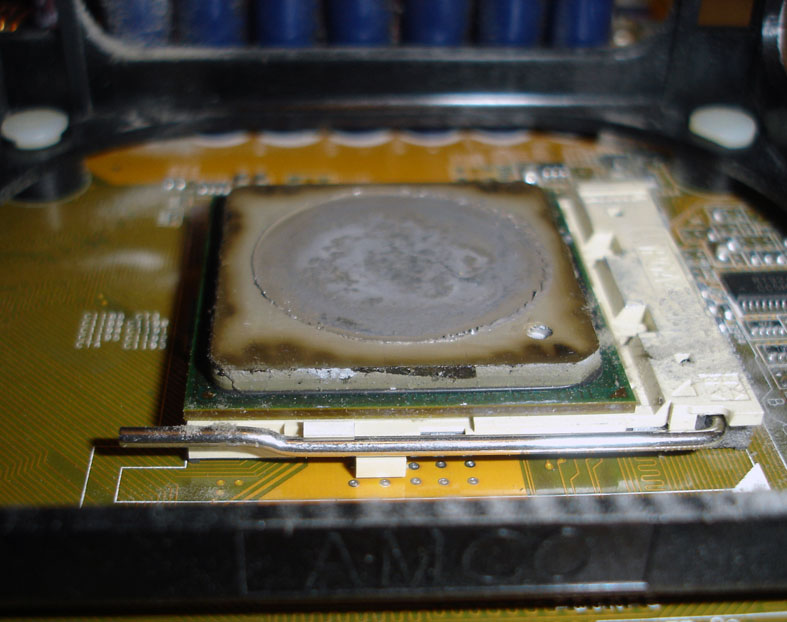
And that brings me to the point whether Intel processors are water-proof and water-resistant. To try it out, I poured some colored-water on the pins of the processor and pinned it on my motherboard. I plugged the PC on... and BOOM... I had just burnt and blasted the Centrino!!

I'm still trying to find that TV on Youtube, but no one's uploaded it yet... May be I'll need to record it and upload it... Will do it as soon as they have it showing again!!

Friday, March 7, 2008

Reasons Why Intel Atom Is Getting Press Coverage

Intel Atom, earlier known by its codename Silverthorne, has got a lot of press coverage lately. And the odd thing is that people have talked so much about it although it isn't seen inside any machines, no one knows its performance and Intel hasn't told which UMPCs will end up with this processor. Also its not a killer processor in terms of design or performance. Then why all the press coverage??

According to me, following are 5 reasons why the Intel Atom is getting so much press coverage:

4.) It's CeBIT Time:

The big trade show from Germany, CeBIT is being held and it's that time of the year when all the hardware journos want to write about something. Motherboard and the CeBIT lobby/booth images are the staple from CeBIT, but there is always buzz around one or two special products. Intel got it right and told the world about Intel Atom just before CeBIT. Journalists were just waiting to write about something and a new Intel product is just what the doctor ordered. Throwing in names are enough. So you have Silverthorne as Atom; another variant with higher TDP called Centrino Atom; another chipset name Poulsbo...

3.) Super Low Power:

Although the world does not know the exact performance of Intel Atom, Intel PR told that its a super low power chip. It claims a TDP of 0.6W - 2.5W, which is commendable. Its targeted towards the small devices where battery life is extremely important. But what about performance?? and what about the chipset power?? A new design and package, completely different set of devices - Mobile Internet Devices (MIDs). Its changing a lot of stuff...

2.) Intel Marketing Rocks:

Is there any tech company that can beat Intel in marketing? "Intel Inside" was the best one in the tech industry and Intel really sold many chips on the back of that campaign. Centrino is also another great one from Intel. The same has to be said about Intel Atom. Codenames on the processor started coming early and the hype was created. Then came the design goals and the target market for the chip. Then slowly info trickled on its architecture and then the logo and roadmap. Perfect information release timing and just about perfect marketing. 

1.) Who Via ??:

If Via was a slightly bigger name and had the same marketing strength, then I guess the Intel Atom story would have been played down. The VIA Isaiah is a great CPU with excellent performance and good power usage. The Centaur (a Via design-lab) guys have an out-of-order processor which is lot more powerful than the Intel Atom. They are targeted at different power usages, but Via could have waited for an Intel announcement and got back at Intel like AMD used to do at IDF. Via didn't do much to publicize and Intel Atom got the coverage.

Saturday, February 23, 2008

Intel To Release Hex-Core Processors

According to Maureen O'Gara from sys-con.com, it seems that Intel is all set to release a processor with Six cores. Yes, you heard me right...six. I think Intel understands that if AMD can start making tri-cores then may be six cores isn't a very bad idea.

The six core or hexacore processor goes by the codename "Dunnington" and has been designed at the Intel Design Center at Bangalore. It is a successor to the Harpertown processors of the Xeon-line of server processors from Intel. It is again supposed to be a sandwich of 3-dies, but this time its 3 dual-core processors that have been stitched together. The cores are sharing a 16MB L3 cache. Like other Penryns, Dunnington still uses a front-side bus. Dunnington is supposed to come at different clock speeds, with a total power consumption of less than 120W.

Intel will be releasing these just before the Nehalem are out and should be an interesting development. AMD on the other hand is just struggling with speed of the processors as well as the manufacturing and releasing of its products. Intel seems to be double of whatever AMD wants to do. AMD Tricore Vs Intel HexaCore.

Sunday, February 3, 2008

AMD gives unreleased Opteron 2352 to Isohunt (P2P servers)

AMD is about to release its bug-free quad-core processors in a few days and has been providing these unreleased processors to a few people for testing. Among the people who received these is http://isohunt.com. Isohunt.com is thanking AMD for providing it with pre-released processors for testing and has "2 pre-production engineering samples" of the Opteron 2352.

Isohunt is supposed to have installed these processors on their primary database servers and have been running them without any problems. The TLB bug which affected the previous Opteron 2350 has been a major headache for AMD and thus has caused delays in production of these chips. The Opteron 2352 runs at 2.1Ghz and has an L2 cache of 2MB.

Isohunt has been on the target of a lot of piracy talk and MPAA and RIAA have already tried their FUD stunts with these guys. Isohunt is a very busy P2P site with a lot of traffic on its torrent trackers. Thus, it seems like a nice place to test your processors in the real-world applications. AMD has given its processors to a nice place and hopefully AMD will work faster in the future.

A yahoo store is selling it at $650 at the moment (but I'm wondering how??)

The CPU Specs as listed by isohunt.com is as below:

Processor: 0
Vendor_id: AuthenticAMD
CPU family: 16
Model: 2
Model name: Quad-Core AMD Opteron(tm) Processor 2352
Stepping: 2
CPU Mhz: 2100.089
Cache size: 512 KB
Physical id: 0
Siblings: 4
Core id: 0
CPU Cores: 4
FPU: yes
FPU_execution: yes
CPUid level: 5
wp: yes
Flags: fpu, vme, de, pse, tsc, msr, pae, mce, cx8, apic, sep, mtrr, pge, mca, cmov, pat, pse36, clflush, mmx, fxsr, sse, sse2, ht, syscall, nx, mmxext, fxsr_opt, rdtscp, lm, 3dnowext, 3dnow, constant_tsc, pni, monitor, cx16, lahf_lm, cmp_legacy, svm, cr8_legacy
Bogomips: 4209.90
TLB size 1024 4K pages
Clflush size: 64
Cache_alignment: 64
Address sizes: 48 bits physical, 48 bits virtual
Power management: ts ttp tm stc [6] [7] [8]

Friday, February 1, 2008

Intel With Core 2 Duo At 3.3Ghz - Great Overclocker

Intel has won this round of the processor wars, but does not want to sit down and watch AMD. Instead, Intel has made up its mind that its going to continue to hammer (... pun intended) at AMD with better processors. Intel will be releasing a 45nm based Core 2 Duo working at 3.33Ghz on the codename-Wolfdale architecture in the next few weeks. Intel already has these in production and you can expect these sometime in Q2 2008.

The model number for these processors is E8600 and will have a total cache of 6MB. These processors will be manufactured on 45nm and are likely to have a TDP of 65W, which is something of an achievement considering these are 3.3Ghz processors. A 65W TDP ensures that there is enough potential for this processor to overclock and the processor won't mind a little more heat that overclocking causes.

By the looks of it, the E8600 is expected to be a good buy since Intel is pricing it lower than the quad-cores. Intel will also be releasing a few mainstream quad cores in March and hence the E8600 will have great price-performance ratio. AMD is going to struggle again to sell its Phenom Tri-Core and Quad-Core chips in Q2 with the E8600 around!!

Wednesday, January 30, 2008

Gateway Selling Phenoms Instead of Intel Quad Core

In what seems to an odd twist to the tale of processor wins, Gateway is offering its high-end desktops with AMD Phenom processors and not with Intel Quad-Cores. All the Intel Quad-Core Processors have been replaced by Phenom 9500 and Phenom 9600 processors. You can find these at the Best Buy shops and it seems a good win for AMD, although how much money AMD is making on these shipments to Gateway is unknown.

AMD's current Phenom, 9500 and 9600 aren't the fastest processors in the market and the Intel Quad-Cores are easily beating them in most applications, if not all. The only advantage that Gateway might be getting by selling these machines is the price advantage. AMD is selling the Phenom processors at good bargain prices and Gateway seems to have even better prices in comparison to Intel's processors.

Gateway is currently selling 3 different configurations with the Phenom processors. The FX7020 gaming PC is priced at $1100 and contains the Phenom 9600. The company is also shipping the first mainstream quad-core PC in retail, the GT5662 at a price of $750 (without monitor) and comes with Phenom 9500, 3 GB of memory, a 256 MB ATY 2400 XT graphics card and a 500 GB hard drive. The high-end multimedia version called the GM5664 is similar to the GT5662, but comes with the Phenom 9600, 1TB harddisk, a hybrid HD DVD/Blu-ray drive and a TV tuner.

The price of these machines is quite competitive and better than a lot of other branded machines. AMD's Phenom seems to enable Gateway to keep the lower prices and still offer customers quad-cores.

Friday, November 30, 2007

Complete Nehalem Details Leaked

True to the earlier reports about Intel's next chips having HT (Hyper-Threading) and integrated-GPU, some more details about Nehalem appeared on the web, courtesy of Japan's PC Watch.

image image

The architecture diagrams mention about 2 threads per core, which was what I had heard from James Reinders earlier. The PCWatch page also has pictures of the updated Intel roadmaps. It also has features of all the different variations of Nehalem that Intel is going to release. The code names of these are Beckton (Oct-core MP), Gainestown (Quad-core DP), Bloomfield (Quad-core, EE-Desktop), Lynnfield (Mainstream Quad-core) and Havendale (Mainstream Dualcore)

Beckton Gainestown Bloomfield Lynnfield Havendale

If you can understand Japanese, then go here and read all about it or use a translator and try to figure out what it means!!