Showing posts with label standards. Show all posts

Wednesday, March 9, 2011

WebGL & Hardware Acceleration in Different Browsers

There is a new race these days in the world of web browsers and it is how fast they can render graphics. As more and more people are trying to make web browsers as the rich media client, we see that hardware acceleration in browsers is getting the next point of race among the web browsers. If JavaScript benchmarking wasn’t enough, most new benchmarks these days are looking towards at WebGL (The JavaScript for 3D) and hardware acceleration in browsers.

There aren’t too many games out there yet, that use the WebGL extensions and so I believe this is another race from the browsers that isn’t about better user experience but more to win points in the benchmarks. Nevertheless, since the worst fairing browser IE9 has improved on the performance of WebGL and uses your computer’s graphics card to accelerate graphics in browsers, it is the every alternate browser’s moral responsibility of sorts to give you enhanced performance. This means that every other browser vendor will now tell you to update your graphics drivers, to prevent crashing of your browser and improve performance. While updating graphics drivers is not what the average computer user would do, the browser manufacturers will blame that crash on the graphics driver.

Here are some numbers comparing browsers in simple WebGL benchmark on a Windows 7 with Intel 2.5Ghz i5 and 4GB of RAM:

Browser (version/platform)

Frames per second (higher is better)

Firefox 3.6.15 6 FPS
Opera 11.01 14 FPS
Chrome 10.0.648.127 12 FPS
Firefox 4 Beta 12 60+ FPS

All browsers in the list are released stable versions, other than Firefox 4 which enables hardware acceleration only version 4 of their browser, but is still unreleased. Clearly, Firefox is very fast and possibly the ones who are running ahead in optimizations of WebGL. Nonetheless, other browsers (Opera 11.50, Chrome 11 and IE9) are also competitively close. I wanted to highlight really how fast things can get with some hardware acceleration.

Wednesday, June 3, 2009

Opera 10 Beta Released and a “Y2K” Discovery for the Web

Opera

Opera has released a beta version of Opera 10, which promises faster web rendering, more accurate standard compliance (e.g. 100/100 on ACID3), Opera Turbo Browsing, Auto-updates and a hell lot of new features. Opera has been well ahead of the curve in terms of features and implementing new standards and Opera 10 is surely on that path.

Y2K-Like Bug Discovered by Opera

While web browsers are one of the most widely used application for computers, not everyone has reached version 10 of the browser. Opera is currently beta testing v10 of its browser and in this process has discovered that a lot of browser detection scripts for websites have a bug of being able to detect only a single digit version number. Much like the Y2K-bug in applications, these browser detection scripts thus think of Opera 10 as Opera 1, and hence show one of these quirky little messages you can see in the image below:

opera10-bankofamerica

While Opera 10 has hacked its way through by renaming its version as 9.80 and putting the browser version in the user-agent part, this problem begs a bigger question to be answered. Opera developers suggest browser-specific hacks and browser detection is not a good thing and such hacks should be avoided. Other people around the web seem to think these web developers need a spanking. While both these opinions are pointing towards the ideal web, none of these are realistic. Because of the way the browsers have understood the ambiguity of web standards differently, the normal web developer has no where to go. There are so many differences in the way IE/Firefox/Opera/Safari render HTML+CSS and execute JavaScript, there isn’t one holy grail that all of us can follow. To adapt to these changes, as web developers we need to hack our ways through some real painstaking quirks. And to avoid some pain, most of us pickup readily available browser detection scripts and feel happy that things work on all the browsers.

This will continue to happen for sometime in the foreseeable future, unless the browser companies sit together and decide how they want to render things... Or the experts from the standards committee write standards that are a little-less ambiguous.

Wednesday, September 3, 2008

Review: Google Chrome

Today, Google released its open-source browser called Google Chrome to the world, after making us feel in 2006 that it was an April Fool’s Joke. Yesterday, in an announcement, it disclosed the features of Google Chrome and claimed that we require a new browser because the web has changed. As soon as it was released, I downloaded it and here are my observations after using it for the last 4 hrs.

The first thing you notice is that it’s an online installer and still requires ~450Kb (for comparisons: utorrent is half the size and can download the whole world for you!!) . It’s only released for Windows at the moment and will require sometime before its released for Linux. The online download was pretty slow for my connection, but I realized that may be half the internet users were downloading it and that can be daunting even for a biggie like Google.

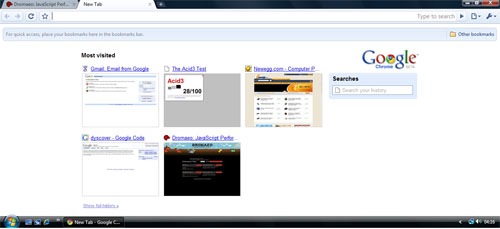
Finally the downloader finished and I was ready to surf on Google Chrome. First thing you’ll notice that it occupies nearly all available screen space. No menubar with File, Edit and the like!! And there is the Opera like UI with SpeedDial for most visited websites and Search History. Also the Address Bar is pretty efficient with all the quick searching and intelligent suggestions.

chrome-speedial

I was expecting Chrome to be memory hog, but it really is pretty light on the memory usage. With less than 10 tabs open, it surely uses less memory than Opera, Safari and surely Firefox. As the tabs increase Chrome seems to take up as much memory as other browsers. The Browser TaskManager, which can be found when you right click on the open Taskbar or TitleBar is another very useful addition to the browser. But what’s interesting to note that with so many security and stability improvements like separate processes and JavaScript sandbox, Chrome has done an excellent job at keeping the memory usage low. May be if addons are introduced, it’ll screw Chrome as well, but for now it’s doing good!!

Google_Chrome

There aren’t many things to be set in the Options that other browsers don’t have, but the search management was interesting. Since, I am from India, it showed me the popular Indian search engines. Yahoo India, MSN India, Rediff, Guruji were the available search engines and that was interesting because it’s always efficient to have a localized search.

This in my opinion is the most important part for a web browser. Like a phone should be best at voice transmission and quality, a browser should be best at displaying websites accurately and swiftly. Chrome uses Webkit (aka Apple Safari’s Engine) for rendering web pages and I wasn’t expecting many differences from Safari. But I found a few changes between the released version of Safari and Chrome. May be Chrome uses a newer version or something. Chrome scores 76/100 on the ACID3 Web Standards test which isn’t really bad, but I was still expecting 100% as Webkit and Opera have already reached 100% in their development products.

JavaScript performance is super fast. You can look at the benchmarks here. The team from Denmark has done an awesome job and Chrome's JavaScript performance is the best among all the browsers.

I'll write more about it later... but you can read what other people at GigaOm, TechCrunch, TheInq and Gizmodo are saying. Its all over the web and no kidding Google OS is really here to stay!!

Wednesday, July 9, 2008

Opera Starts Classroom For Web Standards

Opera announced today that it has launched an education initiative to teach people about web standards. The first part of the initiative is called the Opera Web Standards Curriculum (WSC) which is a curriculum covering the different web standards available today. The program constitutes of articles that are meant to be learning material for educational institutions as well as web developers.

The topics covered as part of the WSC include CSS, HTML, JavaScript, DOM and different concepts about the Web. All the material that is released as part of WSC will be available completely free under the Creative Commons License and can be found here. Over 50 articles on different topics have been planned and well-known Web developers such as Christian Heilmann and Mark Norman "Norm" Francis of Yahoo!, Peter-Paul Koch of quirksmode.org, Jonathan Lane, Linda Goin, Paul Haine, Roger Johansson of 456bereastreet, and Jen Hanen will be contributing the articles.

Opera has been one of the forefront browser supporting web standards. They were also the first to complete ACID3 test successfully and eventhough they still haven’t released a stable build that passes the test, it shows their commitment to support web standards. With so much talk about web standards, it is really odd to find so many websites that work properly only on IE. Its a shame that developers still don’t follow web standards and such initiative can only be useful if web developers realize that users are pissed off looking at non-standard websites.

Wednesday, May 21, 2008

Office 2007 to Support ODF in SP2

According to News.com, Microsoft will be supporting ODF (Open Document Format) in Office 2007 through Service Pack 2 (SP2). Office 2007 SP2 is expected to be released in Q1 2009 and will be adding support for saving and opening ODF files, just like other competing office suites like OpenOffice has been doing.

Microsoft recently had been criticized widely for the ISO standardization of its OOXML format (docx, pptx...etc). The entire community of open-source document suites was against the standardization of OOXML. Thus, this announcement comes as a surprise after the recent tussle with the ODF community. Along with ODF, Microsoft will be increasing compatibility and support for Adobe's Portable Document Format (PDF) and XML Paper Specification (XPS).

Tom Robertson, general manager of Interoperability and Standards at Microsoft, said:

"We have heard from customers and governments that they would like to see us do this. Now is the time to announce this support. It's also important to announce this now because we want to get involved in the maintenance of ODF. We have ongoing dialogue with the EC, so we will absolutely have a discussion with them about these steps [supporting ODF] and get whatever feedback they may have on it".

Microsoft also has plans to join the Organization for the Advancement of Structured Information Standards, or OASIS, which is the primary body for the standardization and improvement of the ODF format. How Microsoft is going to affect the future of document standards is really an important question that everyone needs to be asking? We will really have to see how Microsoft is welcomed by others in the community after the recent clash between the two formats!

Wednesday, March 26, 2008

Opera Reaches 100/100 ACID3, But Will Webkit Release First

Update: Webkit's latest build has passed ACID3 with 100/100 and is rendering it pixel perfect as well with r31356.

Update 2: Opera has released the WinGogi build that passes the test. The build can be downloaded here: Windows, Linux. (Its really not a browser and has some problems...)

ACID3 was released just a few days back and I had written about the Race to ACID3. And Indeed, it "was" a fast race!! Did I just say "was"?? Yes, we can all start to guess the winner of the race and it seems Opera is the first to announce it has reached 100/100 on the test. But it really isn't about what the devs say, I'm gonna give the cup to them only when they release the working preview to the world.

The good news is that WebKit (aka Safari nightly) isn't behind. It has reached 98/100 on the latest build. This isn't much of a surprise since they have been going fast on the development in winning the race. They have been regularly updating the world on what's the condition of compatibility to ACID3 and giving nightly (compiled every night) builds to download.

And thus we come to conclude that whether it will be the open-source project of WebKit that will release its nightly that reaches 100/100 or Opera which is closed source and may require some effort to put its build out to the world. Opera has it running on a test HTML renderer app for Windows called WinGogi and not on the Opera browser. I bet on Opera winning this one, coz it really shouldn't take much time to package the renderer once the hard part of flushing the bugs have been done... But did I say underestimate the strength of the community ??

Thursday, March 6, 2008

Race to ACID3 Just Began

Just when you downloaded the latest beta of IE8 and thought the web was becoming a standard complaint world, the guys from Web Standards Project  just changed the rules of the game. The guys behind the famous ACID tests, called WaSP have just launched the latest version of their test called ACID3 and to no one's surprise, every browser out there fails the test.

Just like previous versions of the ACID2 test, with this version no browser seems to pass the test. About 3 years after the release of ACID2, Microsoft's IE8 passed the test and everyone clapped. But now to their sadness, they have to deal with ACID3 to claim they are standards compliant.

According to WaSP:

Acid3 goes beyond the CSS tests implemented by Acid2 and tests a browser’s DOM Scripting capability, as well as continuing to probe visual rendering of CSS, SVG and webfonts. Further information can be found on the Acid3 page, in the press release, or you can just go ahead and take the test.

Safari was the first web browser to pass the test, with the passing version 2.02 released on October 31, 2005. This time, the race has already begun and everyone from the browser development team wants to be the first to complete the ACID3. You can look at the current state of browser wars on ACID3 here. The latest build of Safari (Webkit) with 87% compliance is already the leader in this race. 100% compliance is really the finish point and you never know which team can suddenly use NOS and win the race.

Tuesday, February 26, 2008

Google doesn't want Microsoft's OOXML to be standard

Google has been bashing Microsoft quite a bit these days. A few days back it was with the Yahoo bid and today its about Microsoft's request to ISO to make OOXML format a standard. For people who haven't heard about OOXML (Office Open XML), its Microsoft's new XML-based format used across Microsoft Office 2007 which replaces Microsoft's earlier binary format. Microsoft has been trying to make OOXML as a standard through ISO, but last time the draft text was not approved by the ISO committee and Microsoft has resubmitted the draft.

Google at its blog mentions that ODF (Open Document Format) is already a standard and Google supports this format. ODF is used across a host of products including Open Office, KOffice, IBM Lotus Symphony and Google Docs but is not supported in Microsoft Office 2007. IBM has shown open criticism earlier regarding OOXML and is very much behind ODF. Sun Microsystems originally developed the ODF format and has also been lobbying against OOXML or transition from OOXML to ODF. The deadline for the vote from the ISO members for making OOXML as a standard is March 30th and Google hopes there is unification of OOXML to ODF.

There are also others who are running a campaign against OOXML becoming a standard. These people have mentioned various problems with OOXML and have been lobbying that ODF should be the standard for documents. Even Microsoft somewhat agreed that there are problems with OOXML, but thinks those can be resolved. Microsoft could easily add a filter to add ODF documents and still keep the docx as default and end the matter. I know Microsoft can lobby and make OOXML, but it would be better for everyone, if Microsoft added ODF to Office 2007 SP2.